
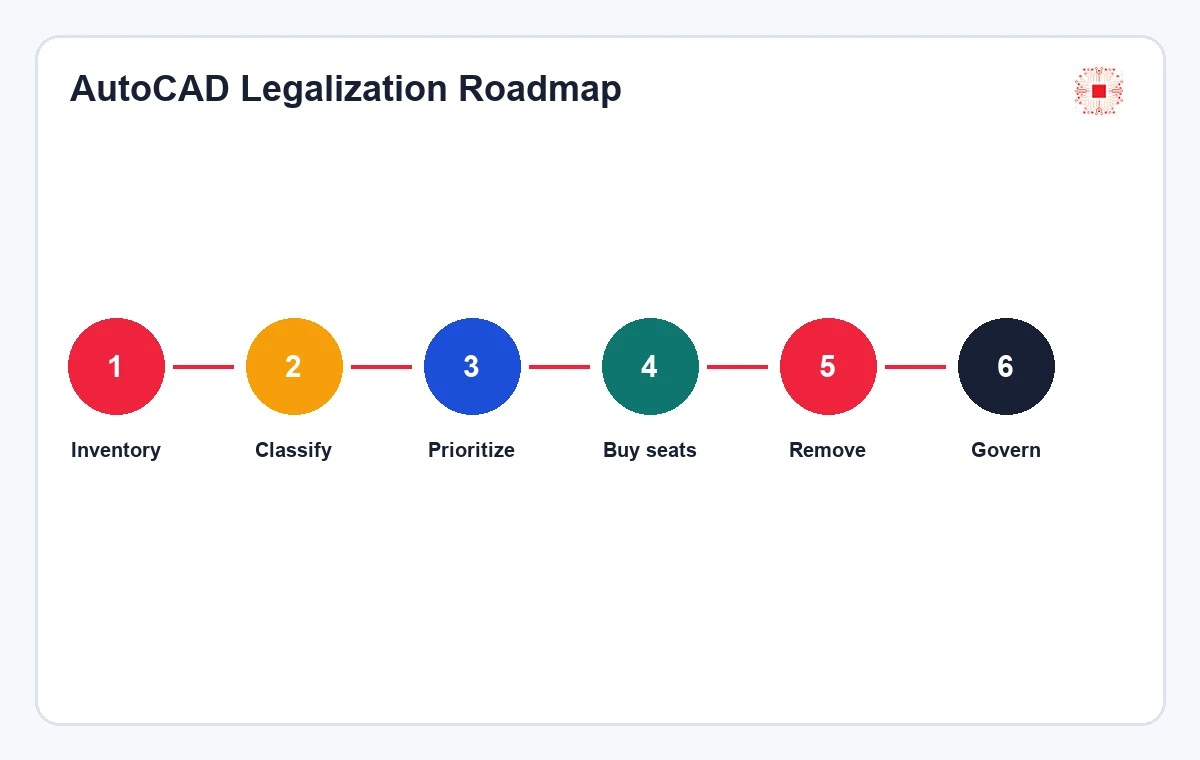
Quick answer: If a company has cracked AutoCAD installations, the safer response is not to buy a few licenses quickly and assume the problem is solved. A better path is to inventory all devices with Autodesk software, classify real CAD users, decide who needs AutoCAD LT, full AutoCAD or another Autodesk product, prioritize high-risk machines, remove unclear installations, buy valid licenses and set up post-purchase governance. Autodesk treats nonvalid or cracked software as unauthorized and associates it with malware, viruses, phishing, data loss, software failure and legal or financial impact. Legalization should therefore be an IT, legal and finance process, not just a purchase.
Need to legalize AutoCAD in your company?
IT Systems can inventory CAD devices, classify AutoCAD LT/full/other Autodesk needs, prepare VAT-ready quotation, support removal of unclear installations and govern licenses after purchase with ITS Manager. Review Autodesk licensing for businesses, AutoCAD licensing and licensed software for businesses.
Why is cracked AutoCAD bigger than license cost?
Many companies start using cracked AutoCAD because they want to save money or because employees install it to solve urgent work. The risk is not only the license fee. CAD workstations often hold construction drawings, factory layouts, mechanical designs, customer files, quotations, contracts and valuable engineering data. If the installer was modified, includes malicious code, cannot update or corrupts project files, the impact can be much larger than the cost of a valid license. For B2B companies, leaked drawings or lost design data can damage trust and project timelines.
This section should become an evidence-based action: owner, data source, deadline, completion criteria and where records are stored. Without evidence, the company can drift back into the same pattern after a few months: new users install software themselves, urgent projects reuse old installers and assigned seats are not reclaimed. IT Systems’ approach is to connect technical data, procurement decisions and user governance into one workflow. Finance should be involved because legalization changes budget planning; legal or management should be involved because the company needs a formal policy; IT should own device evidence and installation control. When these roles are clear, legalization becomes a repeatable operating process instead of a one-time cleanup.
Risk table: continuing with cracked AutoCAD
The table below helps management, finance and IT treat cracked AutoCAD as a governance risk, not a small technical issue. Each row should have a clear owner: IT handles inventory and removal, department heads confirm real need, finance/legal checks evidence and management approves budget. With owners, the legalization process becomes calmer and less emotional.
This section should become an evidence-based action: owner, data source, deadline, completion criteria and where records are stored. Without evidence, the company can drift back into the same pattern after a few months: new users install software themselves, urgent projects reuse old installers and assigned seats are not reclaimed. IT Systems’ approach is to connect technical data, procurement decisions and user governance into one workflow. Finance should be involved because legalization changes budget planning; legal or management should be involved because the company needs a formal policy; IT should own device evidence and installation control. When these roles are clear, legalization becomes a repeatable operating process instead of a one-time cleanup.
| Risk | Impact | Response |
|---|---|---|
| Malware/keylogger | Account and project-data exposure | Remove unclear installs and check endpoints |
| DWG/file issues | Project delays and design quality risk | Back up, install valid software, test files |
| Legal/financial impact | Weak proof of usage rights | Buy valid licenses and store evidence |
| Overuse/shared account | Terms and audit risk | Assign named users, avoid shared credentials |
| Idle seats | Waste after legalization | Track with ITS Manager |
Step 1: inventory devices with AutoCAD and Autodesk software
Before buying, the company needs to understand the real state: which devices have AutoCAD, AutoCAD LT, Revit, 3ds Max or other Autodesk software installed; which versions exist; which users use them; which departments own them; and whether project machines, personal machines or old devices are still in use. Verbal checking is usually incomplete because users may not report accurately or may not know what is installed. IT Systems recommends endpoint inventory and comparison with the existing device list to create objective evidence.
This section should become an evidence-based action: owner, data source, deadline, completion criteria and where records are stored. Without evidence, the company can drift back into the same pattern after a few months: new users install software themselves, urgent projects reuse old installers and assigned seats are not reclaimed. IT Systems’ approach is to connect technical data, procurement decisions and user governance into one workflow. Finance should be involved because legalization changes budget planning; legal or management should be involved because the company needs a formal policy; IT should own device evidence and installation control. When these roles are clear, legalization becomes a repeatable operating process instead of a one-time cleanup.
Step 2: classify LT, full AutoCAD and other Autodesk needs
Not every device that once had AutoCAD installed needs full AutoCAD. Some users only view or edit 2D DWG files. Others need 3D, Revit or 3ds Max instead of AutoCAD. After inventory, interview users by role: file type, usage frequency, active project, deadline, toolset needs, web/mobile needs and whether an alternative workflow exists. The AutoCAD LT vs full AutoCAD article is a useful reference for user segmentation.
This section should become an evidence-based action: owner, data source, deadline, completion criteria and where records are stored. Without evidence, the company can drift back into the same pattern after a few months: new users install software themselves, urgent projects reuse old installers and assigned seats are not reclaimed. IT Systems’ approach is to connect technical data, procurement decisions and user governance into one workflow. Finance should be involved because legalization changes budget planning; legal or management should be involved because the company needs a formal policy; IT should own device evidence and installation control. When these roles are clear, legalization becomes a repeatable operating process instead of a one-time cleanup.
Step 3: prioritize high-risk machines first
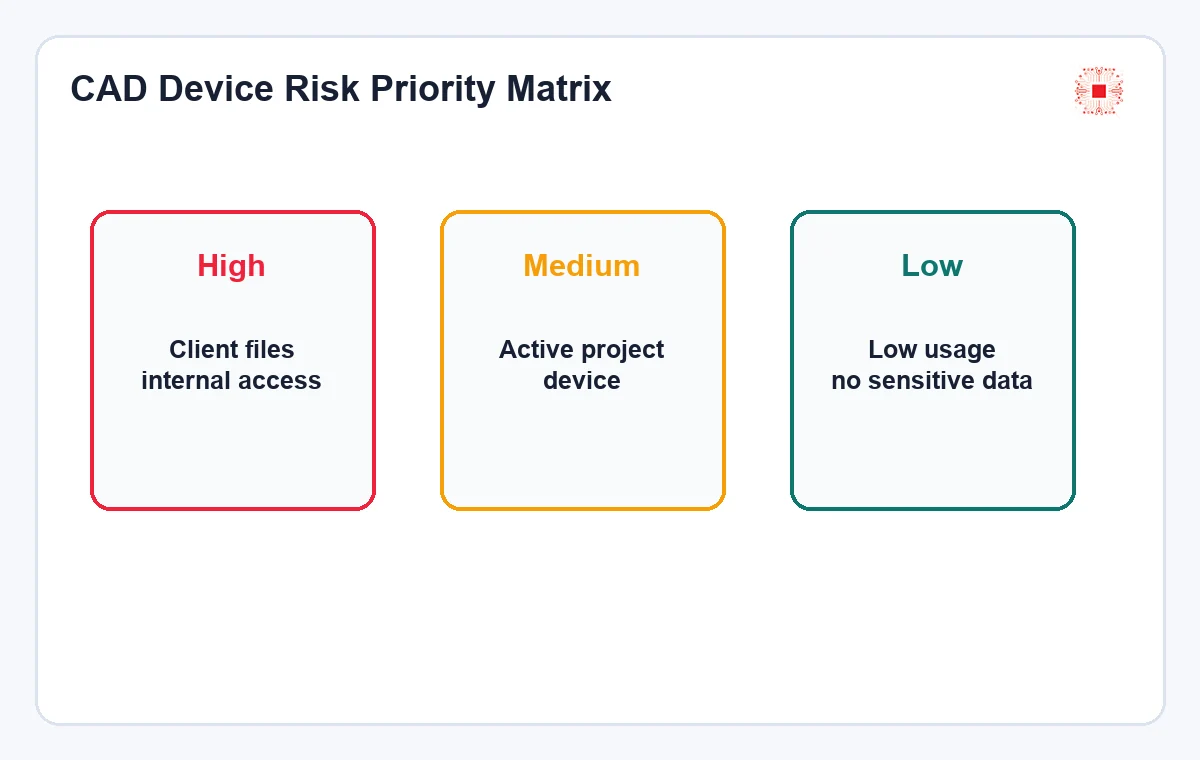
If the budget does not allow everything to be fixed on day one, prioritize by risk: machines with client files, core engineers’ devices, devices connected to internal data, computers with server/NAS access, machines used on active client projects and computers with many cracked tools. This priority model reduces the most serious risk first while keeping spending under control. Low-use machines can be handled later as long as there is a documented plan.
This section should become an evidence-based action: owner, data source, deadline, completion criteria and where records are stored. Without evidence, the company can drift back into the same pattern after a few months: new users install software themselves, urgent projects reuse old installers and assigned seats are not reclaimed. IT Systems’ approach is to connect technical data, procurement decisions and user governance into one workflow. Finance should be involved because legalization changes budget planning; legal or management should be involved because the company needs a formal policy; IT should own device evidence and installation control. When these roles are clear, legalization becomes a repeatable operating process instead of a one-time cleanup.
Step 4: buy valid licenses and remove unclear installations
After classification, the business can choose the right path: AutoCAD licensing, AutoCAD LT, full AutoCAD or another Autodesk licensing product such as Revit or 3ds Max. Removal should be controlled: back up project files, check important plugins, LISP routines and templates, install valid software, test file opening, assign users and store purchase evidence. Do not leave cracked and valid installations side by side unless IT has verified the machine carefully.
This section should become an evidence-based action: owner, data source, deadline, completion criteria and where records are stored. Without evidence, the company can drift back into the same pattern after a few months: new users install software themselves, urgent projects reuse old installers and assigned seats are not reclaimed. IT Systems’ approach is to connect technical data, procurement decisions and user governance into one workflow. Finance should be involved because legalization changes budget planning; legal or management should be involved because the company needs a formal policy; IT should own device evidence and installation control. When these roles are clear, legalization becomes a repeatable operating process instead of a one-time cleanup.
30-day roadmap to legalize AutoCAD
The 30-day roadmap below fits SMEs with several CAD devices but unclear license data. The goal is to move from poor visibility to control of the most important risks, not to solve everything through a rushed purchase. After 30 days, the company should have device inventory, user list, license list, purchase/renew/reclaim actions and an approval workflow for future CAD installation.
This section should become an evidence-based action: owner, data source, deadline, completion criteria and where records are stored. Without evidence, the company can drift back into the same pattern after a few months: new users install software themselves, urgent projects reuse old installers and assigned seats are not reclaimed. IT Systems’ approach is to connect technical data, procurement decisions and user governance into one workflow. Finance should be involved because legalization changes budget planning; legal or management should be involved because the company needs a formal policy; IT should own device evidence and installation control. When these roles are clear, legalization becomes a repeatable operating process instead of a one-time cleanup.
| Phase | Action | Outcome |
|---|---|---|
| Day 1-5 | Inventory CAD devices, users and versions | Current-state list |
| Day 6-10 | Classify LT/full/Revit/3ds Max needs | Real demand map |
| Day 11-15 | Prioritize high-risk machines | Fastest risk reduction |
| Day 16-25 | Buy seats, install valid software, remove cracks | Cleaner critical devices |
| Day 26-30 | Set license and renewal governance | Sustainable process |
Step 5: govern licenses after purchase with ITS Manager
Legalization only lasts if post-purchase governance exists. ITS Manager software license management records users, devices, installed software, licenses, evidence, renewal dates, assignment status and reclaim history. When an employee leaves, the license reclaim process should prevent AutoCAD seats from staying idle. When the company needs more seats, the same data supports faster and more accurate software license quotation.
This section should become an evidence-based action: owner, data source, deadline, completion criteria and where records are stored. Without evidence, the company can drift back into the same pattern after a few months: new users install software themselves, urgent projects reuse old installers and assigned seats are not reclaimed. IT Systems’ approach is to connect technical data, procurement decisions and user governance into one workflow. Finance should be involved because legalization changes budget planning; legal or management should be involved because the company needs a formal policy; IT should own device evidence and installation control. When these roles are clear, legalization becomes a repeatable operating process instead of a one-time cleanup.
What should not be done when cracked AutoCAD is found?
Do not delete everything before backing up project data. Do not force every user into one license type. Do not buy licenses only by counting cracked installations before validating real need. Do not use personal email to receive business licenses. Do not send only a prohibition memo without a replacement path. And do not treat legalization as IT’s problem alone; it requires leadership, finance, legal if available, department owners and technical users.
This section should become an evidence-based action: owner, data source, deadline, completion criteria and where records are stored. Without evidence, the company can drift back into the same pattern after a few months: new users install software themselves, urgent projects reuse old installers and assigned seats are not reclaimed. IT Systems’ approach is to connect technical data, procurement decisions and user governance into one workflow. Finance should be involved because legalization changes budget planning; legal or management should be involved because the company needs a formal policy; IT should own device evidence and installation control. When these roles are clear, legalization becomes a repeatable operating process instead of a one-time cleanup.
How IT Systems supports AutoCAD legalization
IT Systems can support the process step by step: assess the current state, inventory CAD devices, classify LT/full/other Autodesk needs, advise license quantity, prepare VAT quotation, support deployment, document handover and set up ongoing governance in ITS Manager. If the business is ready to buy, review the Autodesk category on IT Systems Shop. If the need is unclear, start with a user and device review.
This section should become an evidence-based action: owner, data source, deadline, completion criteria and where records are stored. Without evidence, the company can drift back into the same pattern after a few months: new users install software themselves, urgent projects reuse old installers and assigned seats are not reclaimed. IT Systems’ approach is to connect technical data, procurement decisions and user governance into one workflow. Finance should be involved because legalization changes budget planning; legal or management should be involved because the company needs a formal policy; IT should own device evidence and installation control. When these roles are clear, legalization becomes a repeatable operating process instead of a one-time cleanup.
FAQ: legalizing cracked AutoCAD
Should a company buy licenses equal to the number of cracked installations? Not automatically; classify real need first. Can data be lost when removing cracked software? The risk can be reduced with backup and testing. Can AutoCAD LT replace full AutoCAD? Only for 2D-focused users; 3D and toolset users need careful review. Does ITS Manager make legal conclusions? No; it provides data for IT and management decisions. Should the issue be handled quietly? No; a formal process prevents recurrence.
This section should become an evidence-based action: owner, data source, deadline, completion criteria and where records are stored. Without evidence, the company can drift back into the same pattern after a few months: new users install software themselves, urgent projects reuse old installers and assigned seats are not reclaimed. IT Systems’ approach is to connect technical data, procurement decisions and user governance into one workflow. Finance should be involved because legalization changes budget planning; legal or management should be involved because the company needs a formal policy; IT should own device evidence and installation control. When these roles are clear, legalization becomes a repeatable operating process instead of a one-time cleanup.
Conclusion: legalize AutoCAD with a staged plan
A company does not need to panic when cracked AutoCAD is found, but it should not postpone the issue either. The best response is to turn it into a small governance project with data, owners, budget, timeline and completion criteria. After the first cleanup, maintain periodic inventory, a CAD installation approval workflow and license review before renewal. This moves the business from reactive cleanup to controlled licensed-software governance.
This section should become an evidence-based action: owner, data source, deadline, completion criteria and where records are stored. Without evidence, the company can drift back into the same pattern after a few months: new users install software themselves, urgent projects reuse old installers and assigned seats are not reclaimed. IT Systems’ approach is to connect technical data, procurement decisions and user governance into one workflow. Finance should be involved because legalization changes budget planning; legal or management should be involved because the company needs a formal policy; IT should own device evidence and installation control. When these roles are clear, legalization becomes a repeatable operating process instead of a one-time cleanup.
Need to legalize AutoCAD in your company?
IT Systems can inventory CAD devices, classify AutoCAD LT/full/other Autodesk needs, prepare VAT-ready quotation, support removal of unclear installations and govern licenses after purchase with ITS Manager. Review Autodesk licensing for businesses, AutoCAD licensing and licensed software for businesses.