


Quick answer: A software license quote for a business should not start only with a short question such as “How much is Office?” or “What is the AutoCAD price?”. In a business environment, the right quote depends on user count, device count, license term, payment model, invoice and procurement needs, current versions, software to replace, deployment support and post-purchase governance. Without enough data, the quote may choose the wrong plan, miss seats, overbuy or fail to address cracked software already installed. Better preparation helps IT Systems advise more accurately and helps the business approve the purchase faster.
Need a software license quote for your business?
Send IT Systems your user count, software groups and current license state if available. The team can recommend the right plan, prepare a formal quote, support deployment and suggest post-purchase governance. You can review the licensed software Store category or the licensed software for businesses page before submitting a request.
A well-prepared request does not need to be perfect. It only needs enough context for the provider to separate an early budget estimate from a purchase-ready quotation. For larger renewals, license cleanups or replacement of cracked software, IT Systems can start with a short discovery step before preparing the formal quote.
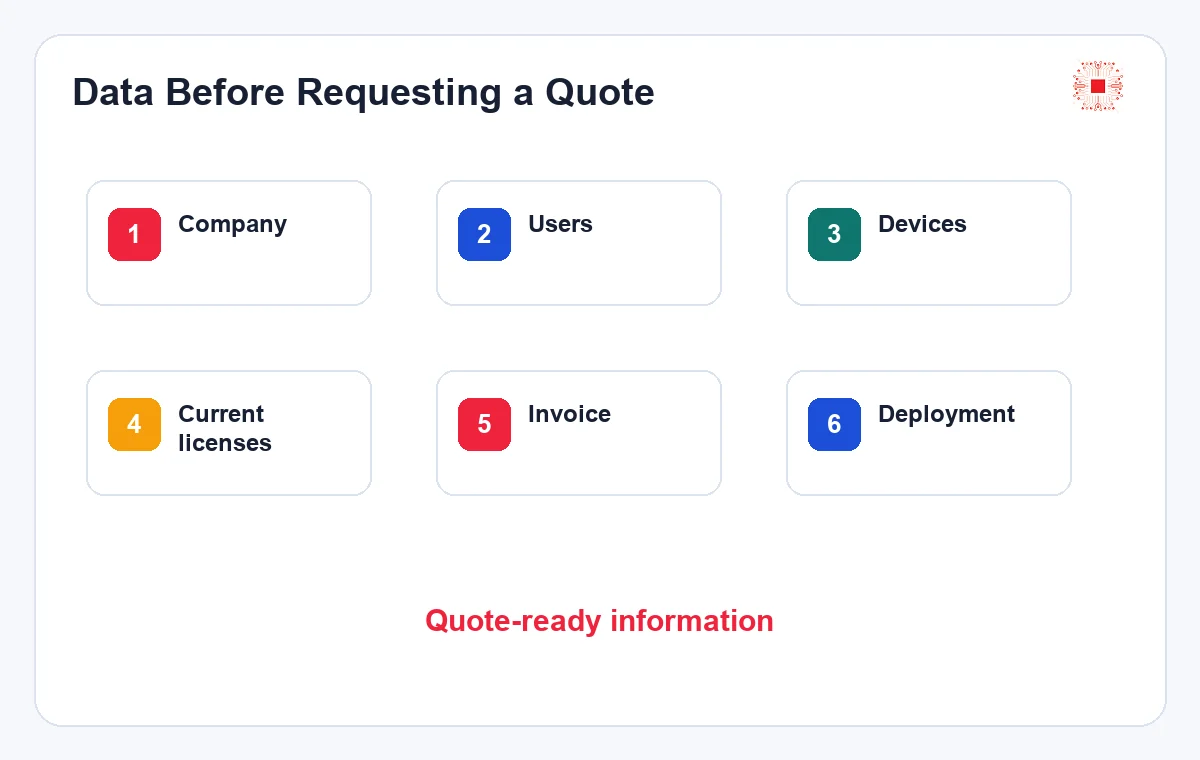
For an SME, the goal is not to turn every quote request into a complicated audit. The goal is to give enough information for a practical recommendation. A ten-user Microsoft 365 renewal, a two-seat Adobe request and a CAD cleanup project should not be handled with the same depth. By clarifying users, devices, current licenses, invoice needs and deployment expectations, the business can receive a quote that is easier to approve and easier to operate after purchase.
This also helps internal teams speak the same language. Finance cares about invoice evidence and renewal cost, department managers care about whether employees can keep working, and IT cares about deployment, security and administration. A good quote request connects those concerns before money is spent.
That preparation becomes reusable for future renewals, employee onboarding, license recovery and internal software audits.
It also reduces urgent last-minute purchases and avoidable rework.
Company, procurement and invoice information
Prepare company name, tax information if applicable, invoice address, purchasing contact, IT contact, quote recipient email, VAT or invoice requirements, payment conditions and target deployment date. This sounds basic, but it affects the speed of the quotation and fulfillment process. If the business has several branches, departments or project-based purchases, state which team will use the software and who approves the budget. For licenses that require a tenant, portal or admin account, the admin owner should also be defined before purchase so that the license can be handed over correctly.
Preparation also improves internal approval. When leadership sees clear users, business reasons, invoice details and deployment impact, the decision becomes easier to compare against budget. A quote without context may look cheaper, but it can create more work later if the selected license does not fit the actual workflow.
User count, device count and usage roles
Each software product can use a different licensing model: user-based, device-based, subscription, perpetual, cloud service, named user or feature-based. The business should prepare actual users, departments, roles, devices and usage intensity. Accountants, office employees, designers, CAD engineers, marketers, project managers and warehouse staff have different needs. If the request only says how many computers the company owns, the provider cannot easily determine who needs Microsoft 365 Business Standard, who needs only email, who needs Photoshop, who only needs Acrobat, who requires full AutoCAD and who can use a lighter option.
Procurement data also prevents delays after approval. Many software orders are slowed down not because the vendor cannot quote, but because invoice information, payer identity, administrator ownership or delivery email is unclear. A clean procurement record helps the business move from quote to deployment with fewer handoffs.
Current software and existing licenses
Before buying more, collect data about installed software and existing licenses. This includes software name, version, seat count, purchase date, expiry date, supplier, invoice, contract, license key, management portal and current user. If the company has many devices, use automated computer inventory by Agent or at least a basic inventory table instead of asking every employee manually. With current-state data, IT Systems can help identify covered licenses, renewals, reclaimed seats, over-installation and unknown software that should be remediated before new purchases.
Role classification is where businesses often save money. Not every user needs the most complete plan. Some users need email only, some need desktop apps, some need advanced security, some need a PDF editor and a small group may need full design or CAD software. The quote should reflect these real work patterns.
Information table to prepare before requesting a quote
The table below is the minimum dataset to prepare for a licensed software quote. Not every field must be complete at the first conversation, but the more data you provide, the more accurate the quote becomes. For companies standardizing licensed software for businesses, this table also turns purchasing into a governance process: who needs the license, why it is needed, which plan fits, who approves it, who deploys it and who tracks it after purchase.
Current-license data prevents duplicate purchases. A company may already have unused seats, old subscriptions, department-owned licenses or user accounts that can be reclaimed. Without this data, buying more seats may temporarily solve the request but leave cost leakage untouched.
| Information Group | Prepare | Why It Matters |
|---|---|---|
| Company | Company name, tax data, address, quote recipient | Correct invoice and procurement flow |
| Users | User count, department, role, license email | Choose the right plan and avoid waste |
| Devices | Installed devices, OS, old/new machines | Clarify user-based or device-based licensing |
| Current state | Existing licenses, invoice, portal, expiry date | Renew, reclaim or purchase correctly |
| Deployment | Target date, admin, migration/installation | Quote the right support scope |
| Post-purchase governance | Owner, renewal date, department cost owner | Keep control after purchase |
Microsoft: Windows, Office and Microsoft 365 quote inputs
For Microsoft licensing for businesses, separate Windows, locally installed Office and Microsoft 365 user subscriptions. For Microsoft 365, prepare mailbox count, email domain, current mail platform, mailbox size, Teams, OneDrive, SharePoint, security needs, mobile devices and admin roles. For Windows, identify the Windows edition currently installed, whether the purchase is for new devices or existing devices and whether Pro features are required. For Office, clarify whether users need basic Word/Excel/PowerPoint or also Outlook, Access, Publisher, cloud storage and real-time collaboration.
The table should become part of the company’s buying habit. Every new purchase should add or update a record: user, department, license term, evidence, renewal date and owner. This turns software procurement into a manageable lifecycle rather than a collection of one-off transactions.
Adobe: Creative Cloud, Photoshop, Illustrator and Acrobat quote inputs
For Adobe licensing for businesses, user roles matter: full-time designers, marketers with light image editing, staff who only need PDF reading/signing, or teams that need Photoshop, Illustrator, Premiere, InDesign and Acrobat. Prepare user count, license email addresses, preferred term, team management needs, project-file version dependencies and cracked software to replace. Adobe purchases are easy to overbuy if All Apps is assigned to users who only need one application, or underbuy if PDF-heavy departments do not receive the right Acrobat capability.
Microsoft quotes can vary widely because the product family is broad. Email-only users, desktop app users, frontline staff and security-conscious teams may require different plans. Asking the right questions early prevents the company from forcing everyone into one plan that is either too weak or unnecessarily expensive.
AutoCAD, Autodesk and CAD software quote inputs
For AutoCAD licensing for businesses, a good quote requires knowing who designs full-time, who only views or edits drawings, whether 2D or 3D work is needed, project count, license term, file format, current version and whether AutoCAD LT or full AutoCAD fits. Prepare CAD workstation lists, user emails, existing license status, other Autodesk products such as Revit, 3ds Max or Civil 3D if used, and cracked-software risk. With CAD software, underbuying or selecting the wrong plan can directly affect project delivery, so role classification before quotation is important.
Adobe quote quality depends heavily on application mapping. A creative team may need All Apps, while a sales or legal team may only require Acrobat. Mapping each role to an application prevents waste and also helps IT explain why certain users receive higher-cost licenses.
PDF, security, backup and specialist software
Beyond Microsoft, Adobe and Autodesk, many companies also need PDF tools, antivirus or endpoint security, backup, remote support, accounting software, graphics tools, video tools, project management applications or AI tools. For these categories, prepare usage needs, user count, operating system, protected data, license term, centralized management requirements and expected budget. You can start from the IT Systems licensed software Store category, but businesses buying for multiple users should still request a quote to confirm the correct model, invoice details and deployment support.
CAD licensing should be tied to project workflow. A project manager who only reviews drawings may not need the same software as the engineer producing DWG files all day. For project-based teams, renewal and reclaim planning can be as important as the initial price.
Comparison table: quick price request vs data-based quote
Many businesses ask for quick pricing first, which is normal. But if the quote will be used for budget approval, procurement and deployment, deeper data is required. The table below shows the difference between the two approaches. A data-based quote may take a few more minutes to prepare, but it significantly reduces the risk of choosing the wrong plan, forgetting existing licenses, missing invoice requirements or leaving no owner after purchase.
Specialist software often needs more context because licensing terms differ by vendor. Security software may depend on endpoints, servers or users. Backup software may depend on storage volume or workload. PDF tools may depend on editing, signing or OCR needs. The quote should capture these differences.
| Factor | Quick Price Request | Data-Based Quote |
|---|---|---|
| Purpose | Budget reference | Purchase approval and deployment |
| Accuracy | May miss plan or quantity | Closer to real need |
| Existing licenses | Often ignored | Compared for reclaim or renewal |
| Crack risk | Hard to detect | Inventory and remediation step |
| After purchase | May remain in email/Excel | Owner, renewal date, ITS Manager |
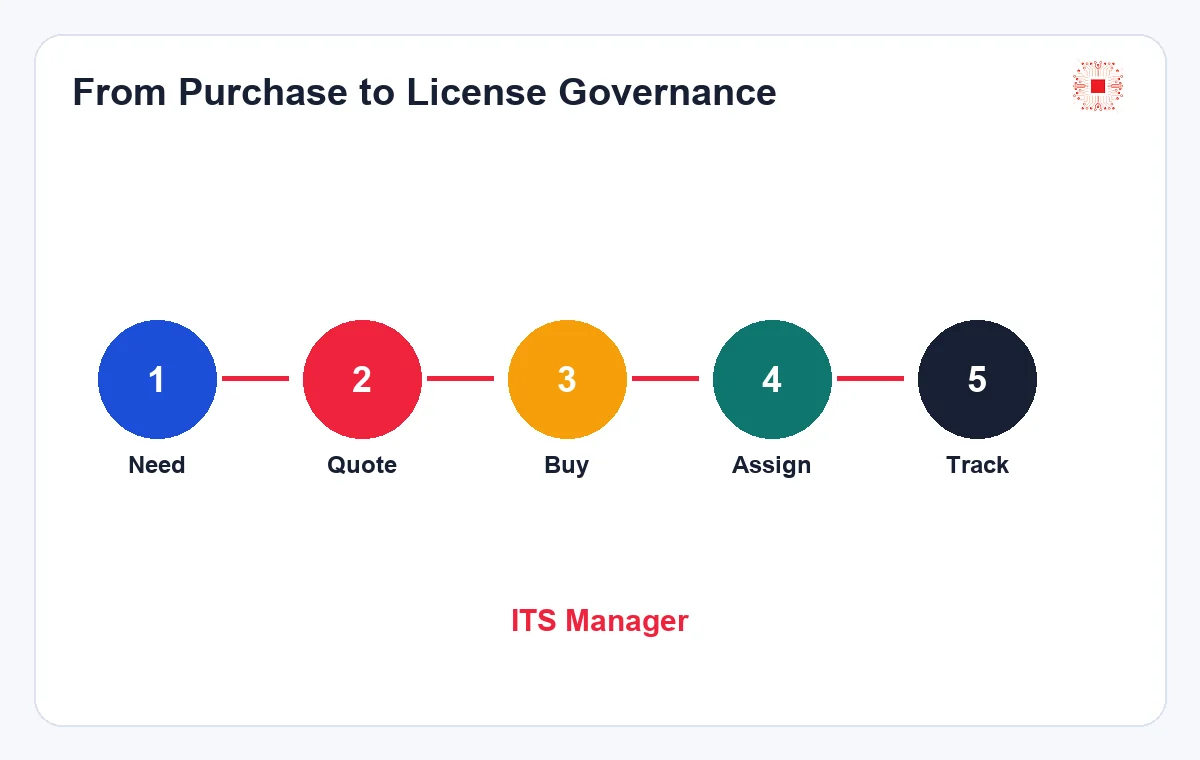
The quote should include deployment and handover
A good quote should include more than software name and unit price. For business use, it should describe support scope: plan selection advice, admin account setup where needed, user assignment, installation support, activation guidance, admin handover, purchase evidence storage and renewal reminders. For Microsoft 365, deployment may involve DNS, MX, SPF, DKIM, DMARC and email migration. For Adobe or Autodesk, deployment may involve user management, official installers, cracked-software removal and post-installation checks.
A quick quote is useful for early budgeting, but a data-based quote is more useful for purchasing. Businesses should know which stage they are in. If the goal is only market reference, a rough range may help. If the goal is purchase approval, a structured quote package is safer.
Managing licenses after purchase with ITS Manager
After purchase, the business still needs to know which license is assigned to which user, which device has the software installed, renewal date, purchase evidence, department owner, unused seats and whether leaver licenses have been reclaimed. This is why ITS Manager software license management should be mentioned during quotation, not only after confusion appears. When software, devices and users are connected in one data source, the business can prepare future purchases, internal audits and cost optimization more easily than by keeping everything in separate emails and spreadsheets.
Deployment support should be explicit. Otherwise the company may approve a license purchase and then discover it still needs DNS changes, tenant configuration, installer cleanup, user assignment or migration work. Clear scope reduces surprise after the order is approved.
When should inventory happen before buying?
Inventory should happen before buying when the business is unsure how many devices have commercial software, has used cracks before, has many leavers, is preparing for a major renewal, has departments buying separately or wants stronger cost control. Inventory can reveal reclaimable seats, shortages, unknown software and old versions that need replacement. For expensive software groups such as Microsoft 365, Adobe Creative Cloud, AutoCAD or specialist applications, inventory before quotation can improve accuracy and reduce emotional overbuying.
Post-purchase governance is where many businesses lose control. The purchase may be correct on day one, but user changes, resignations, device replacements and project endings can make records inaccurate. ITS Manager helps keep the operational picture connected after the invoice is paid.
How IT Systems receives and processes quote requests
A practical process starts with need collection, software grouping, user and device clarification, current-license review if needed, plan recommendation, formal quotation, VAT/payment confirmation, deployment support, handover and optional post-purchase license governance. Simple requests can receive a fast quote. Larger requests or environments with cracked-software risk should include deeper review. This approach positions IT Systems not only as a software supplier, but as a partner helping businesses operate licensed software in a controlled way.
Inventory before purchase is not always necessary, but it is valuable when the environment is unclear. The first review may reveal that the business needs fewer new licenses than expected or that the real risk is cracked software rather than shortage alone.
Software license quote FAQ
Does a business need to send every computer list at the beginning? Not always, but it is recommended for multi-seat purchases or suspected over-installation. Can IT Systems provide VAT/invoice support? IT Systems can support formal quotation and invoice workflow based on proper company information. Can the quote include several options? Yes, comparing basic, sufficient and long-term optimized options is often useful. Should the business buy by employee count or device count? It depends on the license model; many cloud products are user-based, while some software depends on devices or installed versions. Should cracked software be removed before purchase? The business should inventory and plan legal replacement to reduce security and legal risk.
The process should be flexible. A small three-seat request should not require a large audit, while a company-wide renewal should not be treated like a casual price check. IT Systems can scale the review depth to match risk, urgency and budget impact.
Need a software license quote for your business?
Send IT Systems your user count, software groups and current license state if available. The team can recommend the right plan, prepare a formal quote, support deployment and suggest post-purchase governance. You can review the licensed software Store category or the licensed software for businesses page before submitting a request.
A well-prepared request does not need to be perfect. It only needs enough context for the provider to separate an early budget estimate from a purchase-ready quotation. For larger renewals, license cleanups or replacement of cracked software, IT Systems can start with a short discovery step before preparing the formal quote.


