
Quick answer: when does Revit LT Suite fit?
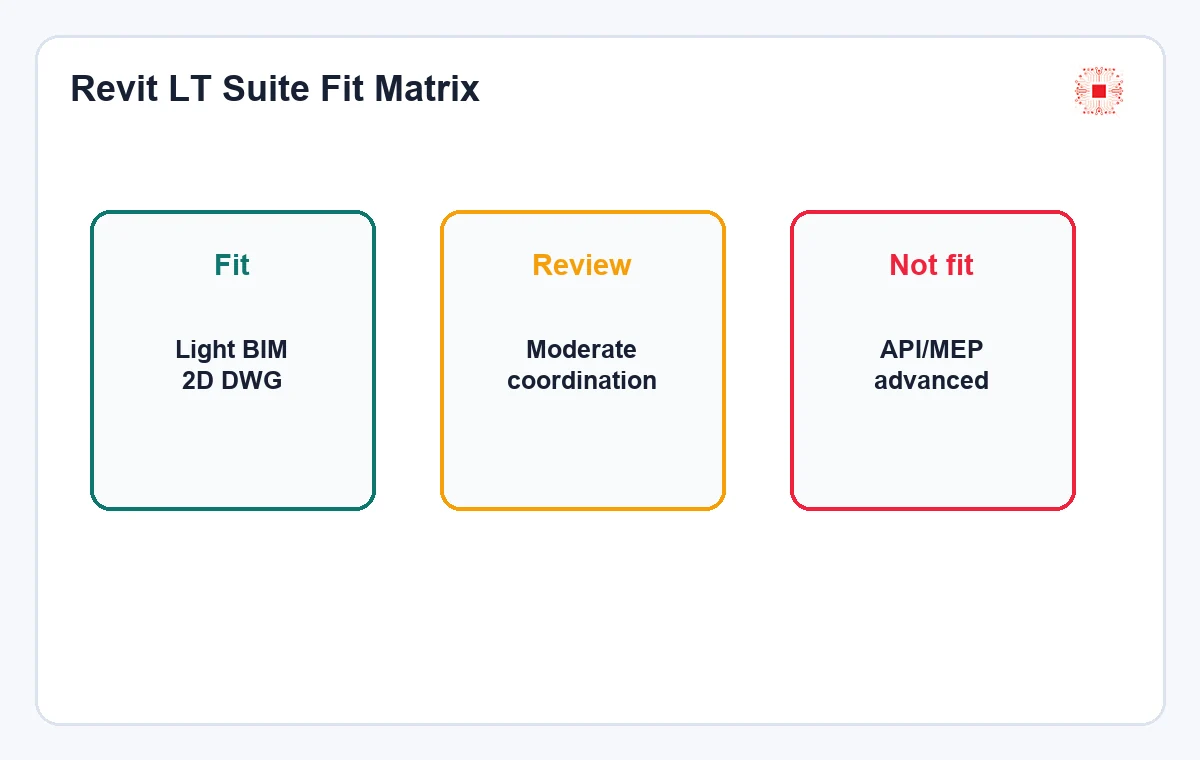
Revit LT Suite fits small architecture teams when the main need is light BIM-based architectural design, basic 3D modeling, documentation and continued AutoCAD LT use for 2D DWG workflows. Autodesk describes AutoCAD Revit LT Suite as combining Revit LT and AutoCAD LT. It is a good option when the team does not yet need full Revit, advanced collaboration, API, analysis or deeper MEP engineering. For a firm moving gradually from 2D CAD to BIM, Revit LT Suite can be a practical bridge between cost and capability.
For a small architecture team, the right buying decision is less about the product name and more about project type, user roles and post-purchase governance. A 5-15 person team usually has several demand levels: architects who model, drafters who edit DWG files, managers who review drawings, finance teams that need invoices and IT teams that need device control. If everyone receives the same package, cost can grow faster than value.
Need to choose Revit LT Suite or full Revit?
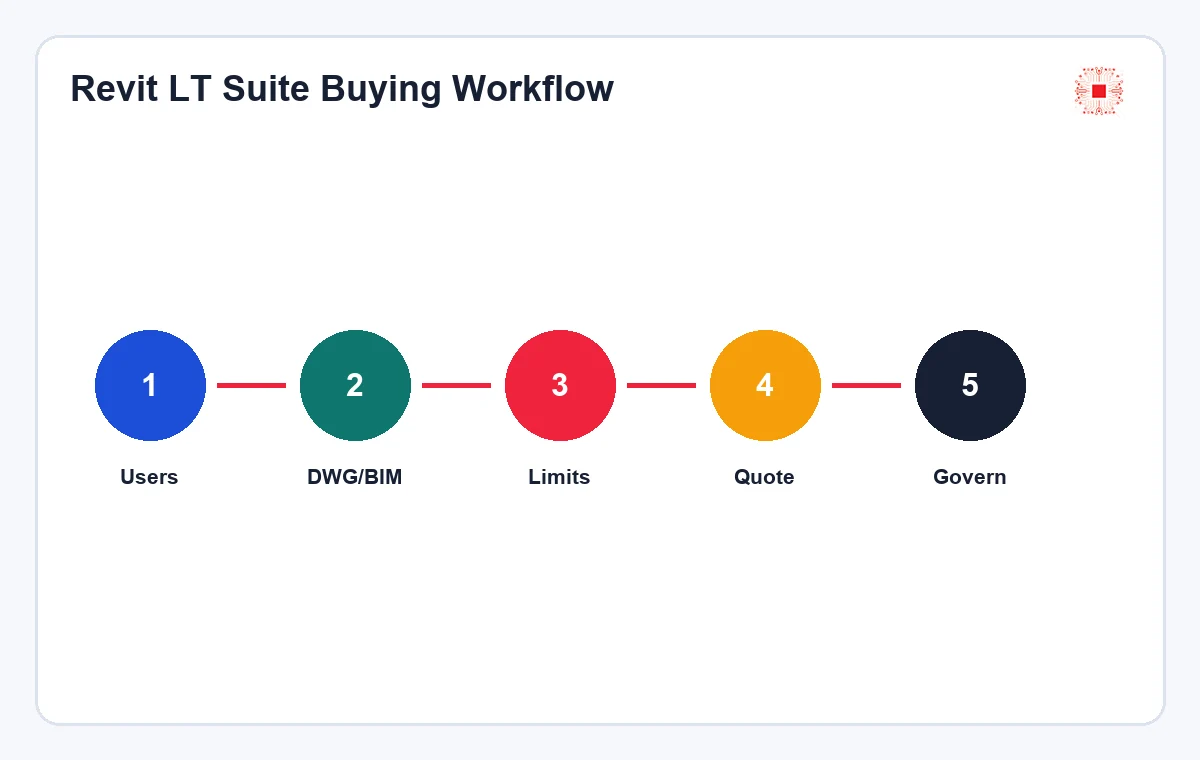
IT Systems can review users, DWG/BIM workflow, project requirements and quote Revit LT Suite or the right Autodesk option. See Autodesk licensing and ITS Manager license governance.
What does Revit LT Suite include?
AutoCAD Revit LT Suite is commonly positioned as a bundle of Revit LT and AutoCAD LT. Revit LT supports lighter architectural BIM modeling and documentation compared with full Revit; AutoCAD LT supports 2D drafting, DWG editing and technical documentation. For a small architecture office, the bundle covers two common needs: continuing DWG work with contractors and partners while starting BIM-based models, sheets, views, schedules and basic visual coordination.
The important point is not to treat Revit LT Suite as the cheapest option, but as the right option for a specific BIM maturity level. If the team does not yet have templates, naming standards, model-sharing rules and only needs basic architectural documentation, a broader product may not create immediate value. If projects already require multidisciplinary coordination, LT can become a limitation. During assessment, the business should ask three extra questions: who actually models, who only opens or edits DWG files, and which projects have explicit BIM deliverables. These questions separate real workflow demand from the pressure to buy the strongest software by default.
From an operations perspective, each license should have a clear owner, device record, renewal date, active project and business reason for assignment. This lets finance see more than the initial purchase price: which licenses support billable work, which licenses sit idle and which licenses should be reclaimed when a person changes role. For small firms, this is often overlooked, yet it decides the real cost after six to twelve months.
Comparison table: Revit LT Suite, full Revit and AutoCAD LT
This table separates needs before purchase. Revit LT Suite is not a full replacement for Revit, and it is not simply AutoCAD LT with a few extras. It sits between them: suitable for small architecture teams that need BIM documentation but not advanced collaboration, analysis, API or complex multidisciplinary workflows.
The important point is not to treat Revit LT Suite as the cheapest option, but as the right option for a specific BIM maturity level. If the team does not yet have templates, naming standards, model-sharing rules and only needs basic architectural documentation, a broader product may not create immediate value. If projects already require multidisciplinary coordination, LT can become a limitation. During assessment, the business should ask three extra questions: who actually models, who only opens or edits DWG files, and which projects have explicit BIM deliverables. These questions separate real workflow demand from the pressure to buy the strongest software by default.
From an operations perspective, each license should have a clear owner, device record, renewal date, active project and business reason for assignment. This lets finance see more than the initial purchase price: which licenses support billable work, which licenses sit idle and which licenses should be reclaimed when a person changes role. For small firms, this is often overlooked, yet it decides the real cost after six to twelve months.
| Factor | AutoCAD LT | Revit LT Suite | Full Revit/AEC |
|---|---|---|---|
| Main need | DWG/2D | 2D + light architectural BIM | Advanced BIM/collaboration |
| BIM | Not the focus | Includes Revit LT | Broader capability |
| Advanced collaboration/API/MEP | Not fit | Limited | Better fit |
| Small team | Good for 2D | Worth reviewing | Needed if project requires |
| Cost | Lower | Balanced | Higher |
Which small architecture teams should consider Revit LT Suite?
Revit LT Suite is worth considering for 3-15 person architecture offices, interior design teams with light modeling needs, residential/small commercial design firms, documentation teams that want to move gradually toward BIM and companies that still exchange DWG files but want more model-based control. The fit is strongest when projects do not require advanced BIM coordination across many disciplines.
The important point is not to treat Revit LT Suite as the cheapest option, but as the right option for a specific BIM maturity level. If the team does not yet have templates, naming standards, model-sharing rules and only needs basic architectural documentation, a broader product may not create immediate value. If projects already require multidisciplinary coordination, LT can become a limitation. During assessment, the business should ask three extra questions: who actually models, who only opens or edits DWG files, and which projects have explicit BIM deliverables. These questions separate real workflow demand from the pressure to buy the strongest software by default.
From an operations perspective, each license should have a clear owner, device record, renewal date, active project and business reason for assignment. This lets finance see more than the initial purchase price: which licenses support billable work, which licenses sit idle and which licenses should be reclaimed when a person changes role. For small firms, this is often overlooked, yet it decides the real cost after six to twelve months.
When should a company not choose Revit LT Suite?
Do not choose Revit LT Suite if the project requires full Revit, advanced worksharing/collaboration, API or add-ins, energy/structural/MEP analysis, advanced MEP engineering or large-scale BIM coordination with owners and contractors. In those cases, saving money with LT can slow delivery or create uncontrolled workarounds.
The important point is not to treat Revit LT Suite as the cheapest option, but as the right option for a specific BIM maturity level. If the team does not yet have templates, naming standards, model-sharing rules and only needs basic architectural documentation, a broader product may not create immediate value. If projects already require multidisciplinary coordination, LT can become a limitation. During assessment, the business should ask three extra questions: who actually models, who only opens or edits DWG files, and which projects have explicit BIM deliverables. These questions separate real workflow demand from the pressure to buy the strongest software by default.
From an operations perspective, each license should have a clear owner, device record, renewal date, active project and business reason for assignment. This lets finance see more than the initial purchase price: which licenses support billable work, which licenses sit idle and which licenses should be reclaimed when a person changes role. For small firms, this is often overlooked, yet it decides the real cost after six to twelve months.
How to classify users before buying
Do not buy one package for the entire team by default. Segment users into 2D DWG editors, BIM modelers, documentation users, reviewers, visualizers and project managers. A 2D-only user may need AutoCAD LT; a light BIM user may fit Revit LT Suite; a complex coordination user may need full Revit or the AEC Collection. The licensed software stack for architecture and construction firms provides the wider context before deciding.
The important point is not to treat Revit LT Suite as the cheapest option, but as the right option for a specific BIM maturity level. If the team does not yet have templates, naming standards, model-sharing rules and only needs basic architectural documentation, a broader product may not create immediate value. If projects already require multidisciplinary coordination, LT can become a limitation. During assessment, the business should ask three extra questions: who actually models, who only opens or edits DWG files, and which projects have explicit BIM deliverables. These questions separate real workflow demand from the pressure to buy the strongest software by default.
From an operations perspective, each license should have a clear owner, device record, renewal date, active project and business reason for assignment. This lets finance see more than the initial purchase price: which licenses support billable work, which licenses sit idle and which licenses should be reclaimed when a person changes role. For small firms, this is often overlooked, yet it decides the real cost after six to twelve months.
Recommendation table by situation
There is no single answer for every architecture firm. A small team running serious BIM projects may need full Revit. A larger team that mostly produces 2D documentation may not. The table below turns the decision into practical questions instead of choosing by product name alone.
The important point is not to treat Revit LT Suite as the cheapest option, but as the right option for a specific BIM maturity level. If the team does not yet have templates, naming standards, model-sharing rules and only needs basic architectural documentation, a broader product may not create immediate value. If projects already require multidisciplinary coordination, LT can become a limitation. During assessment, the business should ask three extra questions: who actually models, who only opens or edits DWG files, and which projects have explicit BIM deliverables. These questions separate real workflow demand from the pressure to buy the strongest software by default.
From an operations perspective, each license should have a clear owner, device record, renewal date, active project and business reason for assignment. This lets finance see more than the initial purchase price: which licenses support billable work, which licenses sit idle and which licenses should be reclaimed when a person changes role. For small firms, this is often overlooked, yet it decides the real cost after six to twelve months.
| Situation | Recommendation | Reason |
|---|---|---|
| Only 2D DWG | AutoCAD LT | No BIM requirement |
| Starting light architectural BIM | Revit LT Suite | Includes Revit LT + AutoCAD LT |
| Multidisciplinary BIM coordination | Full Revit/AEC | LT may limit workflow |
| Separate visualization team | Review 3ds Max/Adobe | Not solved by LT Suite alone |
| Unclear current state | Inventory first | Avoid wrong or excess purchase |
Revit LT Suite cost should be viewed as TCO
Revit LT Suite is attractive because it may control license cost better than broader options, but TCO is not only the license price. Consider training, workflow migration from CAD to BIM, templates, families, naming standards, device readiness, coordination time with partners and upgrade path when projects become more complex. Used correctly, LT Suite can control budget. Used incorrectly, hidden cost appears as rework and awkward workflows.
The important point is not to treat Revit LT Suite as the cheapest option, but as the right option for a specific BIM maturity level. If the team does not yet have templates, naming standards, model-sharing rules and only needs basic architectural documentation, a broader product may not create immediate value. If projects already require multidisciplinary coordination, LT can become a limitation. During assessment, the business should ask three extra questions: who actually models, who only opens or edits DWG files, and which projects have explicit BIM deliverables. These questions separate real workflow demand from the pressure to buy the strongest software by default.
From an operations perspective, each license should have a clear owner, device record, renewal date, active project and business reason for assignment. This lets finance see more than the initial purchase price: which licenses support billable work, which licenses sit idle and which licenses should be reclaimed when a person changes role. For small firms, this is often overlooked, yet it decides the real cost after six to twelve months.
Managing Revit LT Suite licenses after purchase
After purchase, the business needs to know who received each license, who still uses it, which device has it installed, which project requires it, when renewal is due and which department owns the cost. With ITS Manager software license management, IT Systems can record evidence, users, devices and assignment status. When an employee leaves or a project ends, licenses should be reclaimed to avoid idle seats.
The important point is not to treat Revit LT Suite as the cheapest option, but as the right option for a specific BIM maturity level. If the team does not yet have templates, naming standards, model-sharing rules and only needs basic architectural documentation, a broader product may not create immediate value. If projects already require multidisciplinary coordination, LT can become a limitation. During assessment, the business should ask three extra questions: who actually models, who only opens or edits DWG files, and which projects have explicit BIM deliverables. These questions separate real workflow demand from the pressure to buy the strongest software by default.
From an operations perspective, each license should have a clear owner, device record, renewal date, active project and business reason for assignment. This lets finance see more than the initial purchase price: which licenses support billable work, which licenses sit idle and which licenses should be reclaimed when a person changes role. For small firms, this is often overlooked, yet it decides the real cost after six to twelve months.
What information should be prepared before requesting a quote?
Before requesting a quote for Revit LT Suite, prepare user count, roles, project types, DWG/BIM/rendering needs, owner BIM requirements, current software, installed devices, desired term, VAT invoice requirements and admin email. If the data is not ready, use the software license quotation checklist. Good preparation speeds quotation and reduces wrong purchases.
The important point is not to treat Revit LT Suite as the cheapest option, but as the right option for a specific BIM maturity level. If the team does not yet have templates, naming standards, model-sharing rules and only needs basic architectural documentation, a broader product may not create immediate value. If projects already require multidisciplinary coordination, LT can become a limitation. During assessment, the business should ask three extra questions: who actually models, who only opens or edits DWG files, and which projects have explicit BIM deliverables. These questions separate real workflow demand from the pressure to buy the strongest software by default.
From an operations perspective, each license should have a clear owner, device record, renewal date, active project and business reason for assignment. This lets finance see more than the initial purchase price: which licenses support billable work, which licenses sit idle and which licenses should be reclaimed when a person changes role. For small firms, this is often overlooked, yet it decides the real cost after six to twelve months.
How IT Systems helps choose Revit LT Suite
IT Systems can review architecture needs, classify CAD/BIM users, compare with Autodesk licensing, advise between Revit LT Suite, AutoCAD LT, full AutoCAD, full Revit or the AEC Collection, support VAT quotation and guide license governance after purchase. If the company has unclear installations, combine this with the AutoCAD legalization roadmap and device inventory.
The important point is not to treat Revit LT Suite as the cheapest option, but as the right option for a specific BIM maturity level. If the team does not yet have templates, naming standards, model-sharing rules and only needs basic architectural documentation, a broader product may not create immediate value. If projects already require multidisciplinary coordination, LT can become a limitation. During assessment, the business should ask three extra questions: who actually models, who only opens or edits DWG files, and which projects have explicit BIM deliverables. These questions separate real workflow demand from the pressure to buy the strongest software by default.
From an operations perspective, each license should have a clear owner, device record, renewal date, active project and business reason for assignment. This lets finance see more than the initial purchase price: which licenses support billable work, which licenses sit idle and which licenses should be reclaimed when a person changes role. For small firms, this is often overlooked, yet it decides the real cost after six to twelve months.
FAQ: Revit LT Suite for small architecture teams
Is Revit LT Suite enough for BIM? It can be enough for light BIM documentation, but not for advanced collaboration, API or analysis. Do firms still need AutoCAD LT if they use Revit LT? Many do because DWG remains common. Should every team member get the suite? No; segment users. Can the company upgrade later? Review the path when project requirements grow. Can IT Systems inventory before quotation? Yes.
The important point is not to treat Revit LT Suite as the cheapest option, but as the right option for a specific BIM maturity level. If the team does not yet have templates, naming standards, model-sharing rules and only needs basic architectural documentation, a broader product may not create immediate value. If projects already require multidisciplinary coordination, LT can become a limitation. During assessment, the business should ask three extra questions: who actually models, who only opens or edits DWG files, and which projects have explicit BIM deliverables. These questions separate real workflow demand from the pressure to buy the strongest software by default.
From an operations perspective, each license should have a clear owner, device record, renewal date, active project and business reason for assignment. This lets finance see more than the initial purchase price: which licenses support billable work, which licenses sit idle and which licenses should be reclaimed when a person changes role. For small firms, this is often overlooked, yet it decides the real cost after six to twelve months.
Need to choose Revit LT Suite or full Revit?
IT Systems can review users, DWG/BIM workflow, project requirements and quote Revit LT Suite or the right Autodesk option. See Autodesk licensing and ITS Manager license governance.