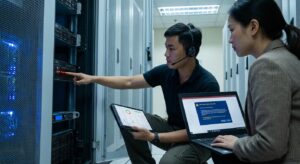
IT helpdesk IT outsourcing service is emerging as a strategic solution to help Vietnamese businesses overcome the challenges of managing IT systems in the digital age. With the rapid development of technology, companies not only need to maintain stable operations but also must be flexible in adapting to constant change. Instead of making large investments in an in-house IT team, the IT helpdesk IT outsourcing service offers professional support from reputable providers, helping to reduce costs by up to 50% compared to the traditional model.
In the context where small and medium-sized enterprises (SMEs) make up a large proportion of businesses in Vietnam, maintaining a fully-staffed IT department is a huge financial burden. IT helpdesk IT outsourcing service solves this problem by providing multi-channel support such as email, chat, phone, and remote access, ensuring a response time of under 15 minutes for high-priority incidents. This service goes beyond basic technical support to include consulting on infrastructure implementation, data security, and business process optimization, helping businesses focus on their core operations.
According to a report from Gartner, over 60% of global businesses have switched to an IT outsourcing model to increase operational efficiency. In Vietnam, this trend is booming with the increasing demand for cloud computing and remote work post-COVID-19. A high-quality IT helpdesk service not only minimizes downtime but also enhances security against increasingly sophisticated cyber threats like ransomware and phishing.
Furthermore, IT helpdesk IT outsourcing service supports the integration of AI and automation, allowing for rapid ticket processing and predicting incidents before they occur. This is particularly important for industries such as finance, manufacturing, and e-commerce, where every minute of interruption can cause millions in losses. Businesses using this service often see a productivity improvement of up to 30%, thanks to a team of experts with international certifications like CompTIA, Cisco, or Microsoft.
In summary, choosing an IT helpdesk IT outsourcing service is not just about cost savings but also an investment in sustainable development. With clear SLAs and transparent reporting, businesses can easily measure ROI, ensuring their IT systems are always ready to support long-term business goals. Consider making the switch today to lead in the technology race.
1. Understanding IT Helpdesk & Outsourcing Services
The IT helpdesk service is becoming a crucial link in solving the human resources puzzle in businesses. As technology continues to evolve, transitioning from traditional IT to outsourced IT services is a strategic move to optimize costs and enhance performance. The IT helpdesk service acts as the first line of technical support, providing fast, professional assistance through multiple communication channels, ensuring businesses operate continuously and effectively.
The role and function of a helpdesk are not limited to resolving technical issues but also include strategic consulting, implementing management systems, and providing technical support tailored to each business. This helps companies, both large and small, optimize their IT systems and minimize downtime-when the system encounters problems and temporarily ceases operation. Especially for SMEs, whether in the IT industry or not, hiring an IT helpdesk service helps them avoid the headache of managing and maintaining complex systems.
- Flexible IT support services: Offering various options suitable for different types of businesses, from simple maintenance to comprehensive management of IT infrastructure.
- Cloud and on-premises services: Helping businesses choose the most optimal and secure IT model, ensuring data safety and system security.
The role of an IT helpdesk IT outsourcing service is to provide flexible solutions that meet the specific needs of each business to contribute to effective growth and scaling. Using an outsourced service is a strategic step for businesses to not only save costs but also optimize IT resources, ensuring stable and secure operations.
2. Benefits of Outsourcing IT Helpdesk Services
Outsourcing IT Helpdesk services brings numerous outstanding benefits to businesses, especially as small and medium-sized companies constantly seek to optimize costs. By outsourcing the service, businesses can minimize operational expenses compared to maintaining their own in-house IT team. This is particularly important as most small businesses lack the financial capacity to bear the additional costs of IT personnel just to handle infrastructure issues like networks, servers, or the cloud.
Additionally, IT Helpdesk services are provided by highly experienced experts, ensuring high-quality consulting and technical support. With flexibility and the ability to customize to each business’s needs, this service ensures that the client’s IT system always operates smoothly, continuously, and efficiently. This helps to minimize operational downtime, a critical factor in securing revenue and labor productivity.
Beyond just providing a service, IT Helpdesk providers also meet the demand for continuous 24/7 support. This completely resolves concerns about IT incidents that can occur at any time, especially outside of business hours. This availability helps businesses maintain stable operations without prolonged interruptions.
Finally, outsourcing IT Helpdesk services reduces the administrative burden on business owners. Company leaders can focus on business strategies instead of worrying about technical issues. This not only saves time but also helps the business optimize resources, concentrating on growth and expansion.
3. The Latest Trends in IT Helpdesk IT Outsourcing Services
Integration of AI agents into support processes is gradually becoming a strong trend in the IT helpdesk IT outsourcing service industry. This not only automates customer care processes but also increases efficiency and reduces operational costs. AI Agents can handle simple requests quickly, reducing the workload on human staff and allowing the business to focus on more complex issues.
Next, the application of cloud computing platforms is helping businesses become more flexible in managing their IT infrastructure. Cloud platforms not only help optimize costs but also increase service scalability, ensuring the system operates continuously and stably. With powerful cloud services, businesses can easily upgrade their IT infrastructure without a large initial investment.
Another notable change is the automation of repetitive support tasks. By using automation tools, businesses can minimize the time spent on trivial tasks and focus on strategic elements. This not only increases operational efficiency but also reduces dependency on manpower.
The trend of shifting to a proactive support model is emerging as a new step to enhance service. Instead of just reacting to problems after they occur, businesses will predict and resolve potential issues in advance, thereby minimizing risks and increasing the reliability of the IT system.
Finally, expanding self-service options for users is a crucial piece in the overall picture of the IT helpdesk IT outsourcing service. With self-service portals and online tutorials, users can solve simple problems on their own, thereby shortening support times and improving the customer experience.
4. Steps to Hire an IT Helpdesk
Identify the business’s support needs
Businesses need to carefully analyze to identify the issues they face within their IT system. Key concerns may include system downtime, data security, and workflow optimization. An IT helpdesk IT outsourcing service can help address these issues at a lower cost than maintaining an in-house IT team.
Choose between an in-house or outsourced model
The decision between hiring in-house staff or outsourcing can significantly impact costs and efficiency. To hire an IT helpdesk provides a flexible and specialized solution without the worry of personnel management, whereas an in-house model requires a long-term investment in people and infrastructure.
Develop hiring criteria and a job description
This is crucial to ensure the right personnel are selected. Criteria should include incident-handling skills, security knowledge, and good communication skills. The job description needs to be specific and clear to attract quality candidates.
Search for and screen candidates or partners
Reputable search channels like LinkedIn and specialized IT service partners should be prioritized. Thorough screening based on the established criteria ensures that the selected individuals or organizations are highly capable of meeting the needs.
Interview and assess professional competence
Preparing detailed questions will help explore the candidate’s or partner’s ability to handle real-world situations, especially the problems the business is currently facing. This is a necessary step to ensure the IT helpdesk service is truly useful and effective for the business.
Select supporting technology and software
An advanced technology system will optimize operational efficiency. Businesses should prioritize software that supports rapid incident resolution, integrates with existing systems, and is flexible enough to meet development needs.
Onboarding and training process for new personnel
Ensure that any hired personnel or in-house staff receive thorough training on both professional skills and company culture. The integration process should include orientation courses to help them quickly understand and catch up with the company’s existing systems and work processes.
5. Leading IT Helpdesk IT Outsourcing Service Providers
Criteria for choosing a service provider: To select a quality IT helpdesk and IT outsourcing service provider, businesses need to focus on reliability, flexibility, and compatibility with their specific needs. The service provider should have extensive experience and a proven track record of maintaining stable operations, minimizing downtime, and improving IT system performance.
Scope of services from reputable providers: Reputable IT helpdesk service providers typically offer comprehensive solutions, from technical support, diagnostics, and troubleshooting to optimizing information technology systems. To hire an IT helpdesk service helps small and medium-sized businesses save on personnel costs while receiving professional and timely support through various communication channels.
- A mandatory professional IT service management (ITSM) platform: For the service to operate effectively, the ITSM platform must be able to automate processes and flexibly integrate with existing systems like CRM or ERP. This not only helps enhance data security but also improves the end-user experience through advanced management tools.
- Essential remote access and support tools: Service providers will grant secure remote access to monitor, manage, and resolve incidents quickly. They need to be equipped with advanced support tools to ensure employees can work effectively from anywhere, minimizing operational disruptions.
6. Best Practices for Implementing an IT Helpdesk Service
Core Value: An IT helpdesk IT outsourcing service is not just about “fixing computers” but is a solution that brings stability, helping businesses focus on their business goals. To hire an IT helpdesk helps optimize costs and ensures the IT system operates continuously, minimizing downtime and thereby enhancing work performance.
Define clear support levels: Classifying support levels is the foundation for handling incidents quickly and accurately. This requires building a clear system for prioritizing issues to ensure all queries or incidents are resolved according to their level of importance and expected performance.
Establish a Single Point of Contact (SPOC): The SPOC model simplifies the communication and response process between the business and the support service. As a result, all information is communicated accurately, minimizing unnecessary efforts from multiple contact points.
Choose the right tools and software: For an IT helpdesk service to operate effectively, using modern tools like management systems and interactive software is crucial. These tools ensure the business receives fast and detailed support while optimizing resolution time.
Build a knowledge base for self-service: Developing a knowledge base is an effective way for users to resolve common issues on their own. This not only helps reduce the load on the support team but also enhances the end-user’s self-service experience.
Establish Service Level Agreements (SLAs): SLAs set commitments on response times and service quality, helping the business track service performance transparently. This is an indispensable part of managing expectations and maintaining a long-term partnership.
Measure performance through Key Performance Indicators (KPIs): Using KPIs to monitor the performance of the IT helpdesk is a transparent, data-driven approach. This allows the business to make quick adjustments when there are deviations from the set performance targets.
Integrate automation and artificial intelligence: Applying automation and AI in support processes helps optimize performance and allocate more resources to high-value tasks. This not only increases processing speed but also improves the end-user experience.
Focus on the end-user experience: Ultimately, all the efforts mentioned above are aimed at improving end-user satisfaction. When their experience is enhanced, it becomes easier for the business to build credibility and establish customer loyalty.
FAQ
When should a business ask IT Systems for support?
Ask for support when the issue affects users, business data, security, licensing compliance, service availability or daily operations. A short technical review often prevents repeated incidents and hidden costs.
Can IT Systems help review the current environment before proposing a solution?
Yes. IT Systems can review the current setup, identify risks, map the issue to the right service scope and recommend a practical next step for your business.
Does this topic connect to ongoing IT operations?
In most cases, yes. Problems around software, cloud, endpoint, network, backup or security should be connected to a broader IT operations plan instead of being handled as isolated incidents.
Need help applying this to your business?
IT Systems Vietnam can help assess the issue, recommend the right service path and support implementation for your team.