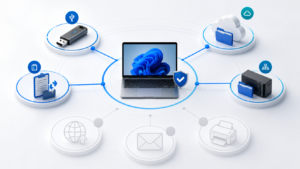
Responsible DLP protects business information without turning the platform into unrestricted personal surveillance. A business should define purpose, collect only necessary signals, limit access, set retention, provide appropriate notice and approve an investigation procedure before broad deployment.
This article provides a practical governance framework and is not legal advice. Specific obligations depend on jurisdiction, employment arrangements, data type and internal policy. Appropriate legal or compliance review should be obtained before rollout.
Why can DLP create privacy risk?
DLP may record user, device, time, file name, path, destination and activity sequence. These signals support investigations, but excessive collection or reuse for unrelated purposes may reveal unnecessary details about employees and their work.
Six principles for responsible DLP
| Principle | Control question |
|---|---|
| Purpose limitation | Which approved business use case needs this signal? |
| Data minimization | Can metadata meet the goal without original content? |
| Transparency | Have employees received clear scope and process information? |
| Access control | Who may view events, evidence and decisions? |
| Storage limitation | How long is evidence kept and how is it deleted? |
| Accountability | Are admin actions, approvals and review paths recorded? |
Define purpose before enabling agents
“Monitor everything” is not a sound governance objective. Use a specific case such as observing project files copied from an approved folder to a USB device outside the allowlist. Every collected field should support an approved purpose.
What data should be collected?
Prefer the minimum metadata and context: endpoint, account, time, action type, file name/type, source, destination, scale and matched rule. Original content, screenshots or deeper personal data require separate assessment, a clear purpose and stronger controls.
- Do not upload original files when metadata is sufficient.
- Mask or hash sensitive fields where practical.
- Avoid personal folders unless the approved use case requires them.
- Distinguish corporate devices from personally owned devices.
- Document which data leaves the endpoint and where it is stored.
What should employee notice contain?
Notice should be understandable and consistent with policy: protection purpose, observed devices and channels, event data, authorized roles, retention, investigation process and a contact for questions. The scope should not remain hidden until an incident occurs.
Role-based incident access
Not every administrator needs full evidence access. Separate agent administration, rule management, triage, investigation and approval roles. Sensitive incidents may require an access reason, immutable admin log and additional approval.
Retention and deletion
Retention should follow purpose and risk, not the platform’s maximum. Define periods for raw events, closed incidents, exported reports and administration logs, then test deletion when those periods expire.
A fair investigation process
- Validate the technical signal before drawing conclusions.
- Check the rule, device, destination and exceptions.
- Collect additional information only as needed.
- Limit identity disclosure to the investigation team.
- Record evidence, decisions and closure basis.
- Correct the conclusion when new context emerges.
An alert is not proof of malicious intent. See DLP false positives for a structured noise-reduction process.
How does a pilot test privacy controls?
A pilot limits endpoints, use cases and time so the team can inspect actual collection, access, evidence quality and operational impact. Approve scope before starting, then report collected fields, exceptions, false positives, admin access and minimization recommendations.
Governance checklist before expansion
- Approved use case and purpose.
- Documented data flow and field inventory.
- Reviewed employee notice and policy.
- Configured roles, MFA and admin logs.
- Tested retention and deletion.
- Owned incident and escalation process.
- Structured reasons for exceptions and false positives.
- Deployment channels match the current DLP coverage.
Frequently asked questions
Is DLP employee-monitoring software?
Its proper objective is to protect data flows and provide evidence for approved use cases, not to measure productivity or monitor private life.
Should employees be informed?
Transparency about purpose and scope is generally important; implementation should follow applicable policy and legal requirements.
Should original file content be stored?
Only when a clear purpose, appropriate basis and strong controls exist. Metadata is usually a less intrusive starting point.
Who should approve DLP?
IT/security, data owners, legal or compliance, HR and the managers responsible for affected processes.
Conclusion
Effective DLP requires both security and trust. Purpose limitation, minimization, access control, retention and fair investigation create useful evidence without expanding surveillance beyond business need.
Use the DLP selection checklist, review the ITS DLP scope or request a privacy-controlled pilot assessment.