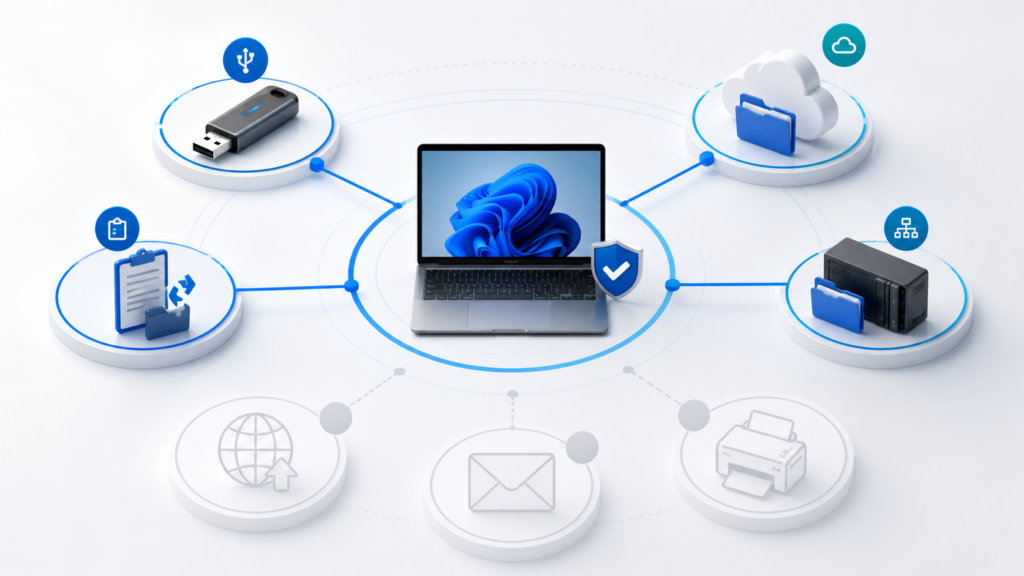
A practical DLP software selection checklist must evaluate five layers: protected data, data channels, detection quality, incident operations and real deployment capability. A product should not win simply because it lists more features. Two tools called DLP may differ substantially across endpoint, cloud, email, web, print, content inspection, privacy and enforcement.
Use this checklist during discovery, demonstrations, proof of concept or pilot. First confirm whether the business needs DLP, then compare the requirement with the current DLP channel matrix.
Quick DLP selection checklist
| Criterion | Mandatory question | Evidence to request |
|---|---|---|
| Use case | Which data, users, action and impact? | Prioritized use-case list |
| Channels | Which endpoint, USB, cloud, email, web and print paths work? | Supported/conditional/unsupported matrix |
| Detection | Metadata, regex, fingerprint, OCR or exact-data match? | Demo with approved sample data and documented limits |
| Action | Audit, alert, block, quarantine or justification? | Test results on representative endpoints |
| Privacy | What is collected, transmitted, stored and viewed? | Data flow, retention and role matrix |
| Operations | Who triages incidents and tunes false positives? | Incident workflow and pilot report |
1. Define use cases before evaluating products
Write each use case as data type, user, source, destination, observable action and impact. “Detect bulk copying of project drawings from an approved folder to removable storage on Windows” is testable; “prevent all data loss” is not.
- Customer records, contracts and pricing.
- Source code, drawings, formulas and designs.
- Personal, HR or financial data.
- Accidental behavior, deliberate misuse or compromised accounts.
2. Build a data-channel matrix
Require vendors to distinguish local cloud-sync folder visibility from direct service audit. Likewise, clipboard copy intent does not prove that data left a device.
| Channel | Verify | Demo question |
|---|---|---|
| USB/removable | Volume, file metadata, device rule and exception | Can approved devices be distinguished? |
| Cloud sync | Local folder or API connector | Is visibility on the endpoint or tenant? |
| Network share | UNC, mapped drive and destination context | How are source and destination shown? |
| Email/web/chat/AI | Agent, proxy, browser extension or API | Which channel is production-ready? |
| Job metadata, content and printer | Is the feature demonstrated or roadmap? |
3. Validate platform and deployment architecture
- Supported Windows, macOS and Linux versions.
- Agent privilege, update, rollback and health monitoring.
- Cloud, on-premises or hybrid data path.
- Offline behavior and secure resynchronization.
- Measured CPU, memory, disk and network impact.
The currently verified ITS DLP endpoint scope is Windows. Review Windows Endpoint DLP capabilities.
4. Separate detection, classification and enforcement
Detection identifies a signal or pattern. Classification adds data and destination context. Enforcement applies an action such as audit, alert, block or quarantine. Ask vendors to label every capability as production, conditional or roadmap.
- File name, extension, size and path.
- Keywords and regular expressions.
- Fingerprinting, exact-data match, OCR or machine learning.
- File count, total bytes and behavior sequence.
- Audit, alert, block, quarantine or user justification.
5. Evaluate incident evidence
An alert without context creates more work. An incident should expose endpoint, user, time, destination, scale, matched rule, activity timeline, owner, notes and resolution state.
- Are related events grouped into a timeline?
- Does risk scoring explain why an incident is prioritized?
- Can reviewers assign, comment, close and mark false positives?
- Are saved views, exports and change history available?
- Is the evidence understandable to management and HR?
6. Review privacy and data governance
DLP can create its own privacy risk when collection is excessive. Confirm which fields leave the endpoint, whether original files are uploaded, whether paths are redacted or hashed, whether samples are masked and how long evidence is retained.
| Area | Minimum requirement |
|---|---|
| Collection | Field inventory and stated purpose |
| Transport | Encryption, agent authentication and anti-tampering |
| Storage | Retention, deletion and storage location |
| Access | Role model, tenant isolation and admin audit |
| Employees | Notice, approval and investigation procedure |
7. Measure operability and false positives
Ask whether IT can operate the system, not only whether it can detect something. A noisy rule that produces hundreds of low-value alerts may cost more than a narrower rule with clear ownership.
- Incidents per day in the pilot group.
- Investigation rate and false-positive rate.
- Average triage time.
- Exceptions by user, group, application, path or device.
- Rule-change workflow and version history.
8. Verify integrations, reporting and SLA
Validate identity, SIEM/SOC, ticketing, alert routing and cloud-audit integrations with a real tenant. A connector skeleton, mock-up or roadmap document is not production evidence.
- SSO, MFA, roles and tenant isolation.
- Alert routing and escalation.
- API, webhook and CSV export.
- Agent and connector health monitoring.
- Support SLA, upgrades, configuration backup and recovery.
9. Calculate total cost of ownership
Total DLP cost includes licenses, implementation, infrastructure, incident review, rule tuning, training, support and upgrades. A low license price may still be expensive when false positives consume staff time.
| Cost area | Clarify |
|---|---|
| License | Per user, endpoint, server, tenant or module |
| Implementation | Discovery, agent, policy, connector and acceptance |
| Operations | Triage, reporting and tuning effort |
| Expansion | Additional channels, endpoints and retention |
| Exit | Data export, agent removal and configuration handover |
10. Require a pilot before broad rollout
A pilot should use representative endpoints, defined use cases, a normal-activity baseline, evidence criteria and accountable reviewers. Its outcome may be expansion, redesign, a narrower scope or stopping.
- Approve scope and privacy.
- Measure legitimate baseline activity.
- Run rules and document exceptions.
- Assess evidence quality, false positives and operational load.
- Produce a decision report for the next stage.
See the business DLP pilot implementation process.
Suggested weighted evaluation model
| Category | Example weight |
|---|---|
| Use-case and channel fit | 25% |
| Evidence and detection quality | 20% |
| Privacy and architecture security | 15% |
| Operations and false positives | 15% |
| Integration and scalability | 10% |
| Implementation, support and SLA | 10% |
| Total cost of ownership | 5% |
Weights must follow business priorities. A total score must never hide a disqualifying condition such as a missing mandatory channel or unacceptable privacy design.
Frequently asked questions
Should we choose the product with the most channels?
Not necessarily. Choose a product that proves the priority channels and can be operated by your team. A listed but unfinished channel creates no practical value.
Is a demonstration enough?
No. A demo validates interface and basic flow; a pilot on representative endpoints and sample data reveals signal quality, performance and false positives.
Is blocking mandatory?
It depends on the use case. Many businesses should begin with audit and alert. Blocking becomes appropriate only after rules, exceptions, rollback and user support are mature.
Does DLP replace access control and training?
No. It complements least privilege, MFA, backup, device management, HR processes and security awareness.
What should the vendor deliver after a pilot?
Request scope, coverage, sample incidents, false positives, rule changes, endpoint impact, remaining limitations and a rollout recommendation.
Conclusion
A DLP checklist turns product claims into testable evidence. Prioritize use cases, channel coverage, collected data, incident operations and pilot results instead of counting features.
Review the current ITS DLP scope or request a pilot assessment.