


Quick answer: what is ECC RAM? ECC (Error-Correcting Code) RAM can detect and correct single-bit errors in data, keeping systems stable and preventing data corruption, freezes and crashes. It is used in servers, workstations and NAS devices, where even small data errors can have serious consequences (finance, cloud, databases). Difference from ordinary RAM: traditional ECC modules have an extra chip to store check codes (for example 9 chips instead of 8 on DDR4), are very slightly slower and cost more. Note: you need a CPU and motherboard that support ECC (Xeon, EPYC, some Ryzen and workstation platforms). DDR5 has “on-die ECC” inside each chip, but it does not replace full (side-band) ECC on server RAM. Should you use it? For servers, NAS and workstations running 24/7 with important data, yes; for office or gaming PCs, ordinary RAM is enough.
ECC RAM is found in workstations and servers. Professionals and businesses value it for its ability to detect and correct data errors, minimising data-related incidents. It is essential for professional users and organisations such as financial institutions and cloud providers, where even the smallest data error can be a disaster.
How is it different from ordinary RAM?
Physically it is very similar. The traditional difference is that an ECC module (DDR4) uses nine chips instead of eight: eight ordinary memory chips plus one used to detect and correct errors in the others.
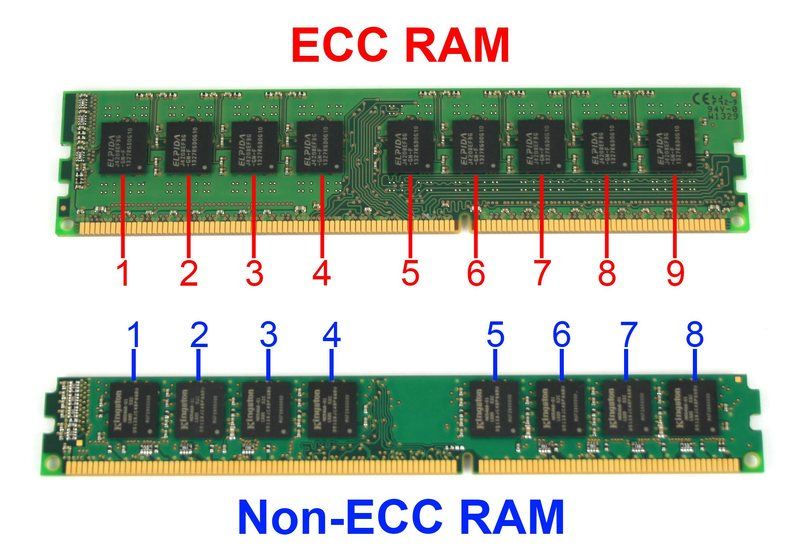
Systems with ECC RAM have a much lower chance of memory-related crashes. A large study by Puget Systems in 2014 found a failure rate of 0.09% for ECC RAM compared with 0.6% for ordinary RAM.
How can you use ECC RAM?
ECC RAM targets business workloads, so most consumer motherboards do not support it, or accept it without using its error-correction feature. To use ECC, you need a workstation or server motherboard and a CPU that supports it. ECC RAM also costs more because it uses more chips.
On Intel, ECC is mainly available on Xeon processors, and on some recent Core processors when used with workstation chipsets (such as W680/W880). On AMD, EPYC and Threadripper PRO support ECC, and many Ryzen processors do on compatible motherboards; check the motherboard’s specifications and memory compatibility list before buying.
How does ECC RAM work?
“ECC” stands for “error-correcting code”, a mathematical method of ensuring data stored in RAM is correct. When an error is detected, ECC can reconstruct the correct data in real time.
Simple parity uses one extra bit to detect an error in a group of data bits (for example 8 bits). The limitation is that a single parity bit can detect an error but does not provide enough information to correct it.
Most PC systems transfer data in 64-bit blocks called words. Instead of adding one bit for every eight data bits, ECC adds extra check bits (eight for every 64 data bits on standard modules) and runs an algorithm on them to verify that the 64 data bits are correct.
If a single-bit error is found, the ECC algorithm can correct it. Errors of two bits or more can be detected and reported to the system, but not corrected.
Registered ECC RAM
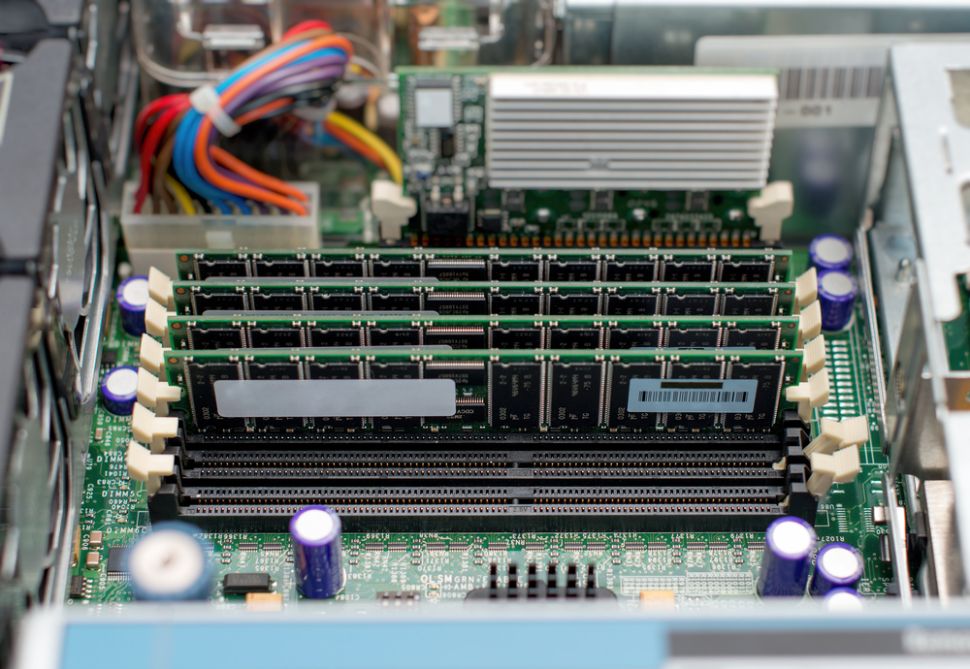
ECC RAM is not necessarily registered, but registered (RDIMM) server memory is almost always ECC.
Registered ECC RAM contains a register between the memory chips and the CPU’s memory controller. Commands go to the register first and then to the memory chips. This reduces the electrical load on the memory controller, improving stability and allowing the system to use more memory modules.
Source: Tom’s Hardware.
See more in our IT knowledge section. For server and NAS hardware advice for your business, contact IT Systems at hotline 028.3995.03.59 or contact@itsystems.com.vn.
Need someone to run your servers, NAS and systems?
IT Systems manages servers, NAS, cloud, backup and user accounts on a schedule, with a monthly operations report.


