Short answer: Direct-attached storage (DAS) connects directly to one server or computer. Network-attached storage (NAS) commonly serves shared files over a network. A storage area network (SAN) is a managed storage-network architecture that presents block volumes to hosts. A virtual storage appliance (VSA) is different: it describes software deployed as a VM, which may expose file or block interfaces depending on the product. Choose by application access type, host count, latency, operating capacity and recovery objectives, not by acronyms or raw terabytes.
This is an architecture comparison. If the question is cloud, NAS or portable media for staff, read the workplace-and-copy comparison. For NAS model sizing see the selection checklist. Synology solutions are one deployment route, not the default answer to every workload.
The four terms describe two different dimensions
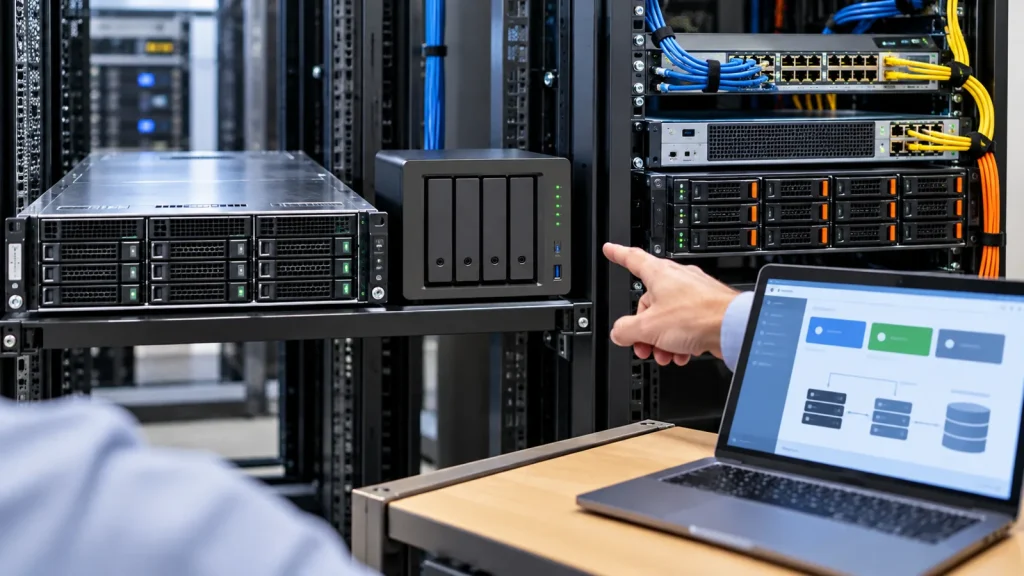
DAS, NAS and SAN usually describe how storage is attached or delivered: directly to a host, as shared files over a network, or as block volumes across a storage fabric. A modern appliance may support SMB/NFS and iSCSI on compatible models. Therefore, the shape of a box does not uniquely define the access protocol. First ask whether the application needs a file share, a block volume for virtualization/databases, or a backup repository.
VSA describes the software deployment form of a storage appliance running as a VM. It still depends on physical CPU, memory, disks and networking, licensing, and host failure domains. Depending on the product it can present SMB/NFS, iSCSI or a gateway interface. Claims that ‘VSA is faster than SAN’ are meaningless without underlying disks, protocol, network and redundancy design.
DAS: close to one host, simple but not directly shared
DAS includes internal server drives and directly connected enclosures or media. It may suit boot volumes, single-host applications and scratch data when a short data path and straightforward ownership matter. Initial complexity can be low, but moving workloads between hosts, simultaneous sharing, expansion and protection against host loss need separate design.
Do not assume a USB disk is production-grade database or VM storage. Verify controller and drive support, RAID or hot-swap where relevant, replacement plan, maintenance window and an off-host copy. If the requirement is merely portable backup media, use the cloud–NAS–external-drive comparison rather than buying a SAN.
NAS: governed shared files
NAS commonly publishes SMB/NFS files over the LAN. It can fit departmental folders, documents, media and some backup repositories with multi-user access. Size for concurrent sessions, file types, usable capacity after drive protection, network, supported snapshot/backup functions and an operator. Synology package and volume capabilities vary by model and DSM release.
A NAS does not automatically replace block storage for every hypervisor, database or ERP. Some supported NAS models can present iSCSI LUNs as block storage; then initiators, multipath and host filesystem or cluster rules must be managed. Never mount one writable LUN on several ordinary hosts as if it were a normal SMB folder.
SAN: block volumes for hosts over a managed fabric
A SAN lets hosts access block volumes through a dedicated storage network/fabric. Fibre Channel and iSCSI are common implementation families. Beyond a file share, a SAN project requires zoning or access control, LUN mapping, multipath, switching, firmware, capacity monitoring and an operating team. It may fit virtualization clusters, transactional systems and supported shared-block HA workloads; most small offices do not automatically need that complexity and cost.
Do not promise that SAN is always faster than NAS. Measure IOPS, throughput, latency, block size, network and concurrency on real workloads. A SAN does not eliminate backup or disaster recovery: logical deletion, bad configuration and corruption can affect many hosts. Validate hypervisor/application support and failover before procurement.
VSA: storage software on virtual infrastructure
A VSA may turn host resources into a storage service or act as a gateway to another backend, depending on its vendor. For example, AWS Storage Gateway can run as a VM and provide file or iSCSI interfaces depending on gateway type. This illustrates why VSA is not a single protocol or performance tier. Other software-defined or hyperconverged offerings have their own HA and licensing rules that must be checked product by product.
A failed VSA host, network path, full underlying datastore or unrecoverable appliance VM may take down storage service. Examine bootstrap dependencies if the host needs storage provided by that same VSA to start. A pilot must cover recovery of the appliance VM, configuration, access keys and backend data, not only a VM snapshot.
Fast decision matrix and acceptance test
One host and one application: evaluate suitable DAS, plus an off-host backup. Shared team files: evaluate NAS or a file server with SMB/NFS, a permission matrix and a healthy network. Several hosts requiring supported block access: evaluate SAN or another supported block product with its fabric and operating burden. Existing virtualization and a specific gateway/SDS requirement: consider a VSA only after checking compatibility, failure domain, bootstrap, licensing and vendor support.
For any option, inventory applications and protocols, usable capacity, two-year growth, representative IOPS/latency, RPO/RTO, warranty, alert owner, a copy outside the failure domain and a tested restore. Accept against real workloads: file and permission behavior, loss of one supported path or host, sample recovery and measured time. Review business backup management and Synology models in Store where NAS fits.
Frequently asked questions
Can a NAS present iSCSI?
Some models can. An iSCSI LUN appears to the host as block storage; validate model support and design initiators, multipath, access and filesystem rules.
Does SAN always mean Fibre Channel?
No. Fibre Channel is one common fabric; iSCSI can deliver block storage over an appropriately designed IP network.
Is VSA a fourth storage type like NAS?
No. VSA describes software packaged as a virtual appliance; a particular product may expose files, blocks or a gateway service.
Do RAID and multipath replace backup?
No. They mitigate selected disk and path faults, not deletion, ransomware or logical failure. Keep an independent copy and perform restore tests.
Technical sources
IBM: DAS and storage architectures; IBM: SAN vs NAS; Microsoft: Windows cluster storage architectures; AWS: virtual gateway appliance. Confirm product version and application support for any deployment.