


DLP PILOT IMPLEMENTATION
DLP pilot implementation for businesses
A DLP pilot validates signals, rules, review workflow and operational impact on a representative endpoint group before the business decides whether to expand. IT Systems uses phased discovery, baseline observation, tuning and evidence review.
Start small, learn from real activity and reduce false positives before making a broader rollout decision.

Why pilot before a broader DLP rollout?
DLP interacts with everyday data workflows. A pilot reveals normal behavior, approved exceptions and the actual review effort required. It prevents the business from applying broad assumptions before it has reliable operational evidence.
Validate signal coverage
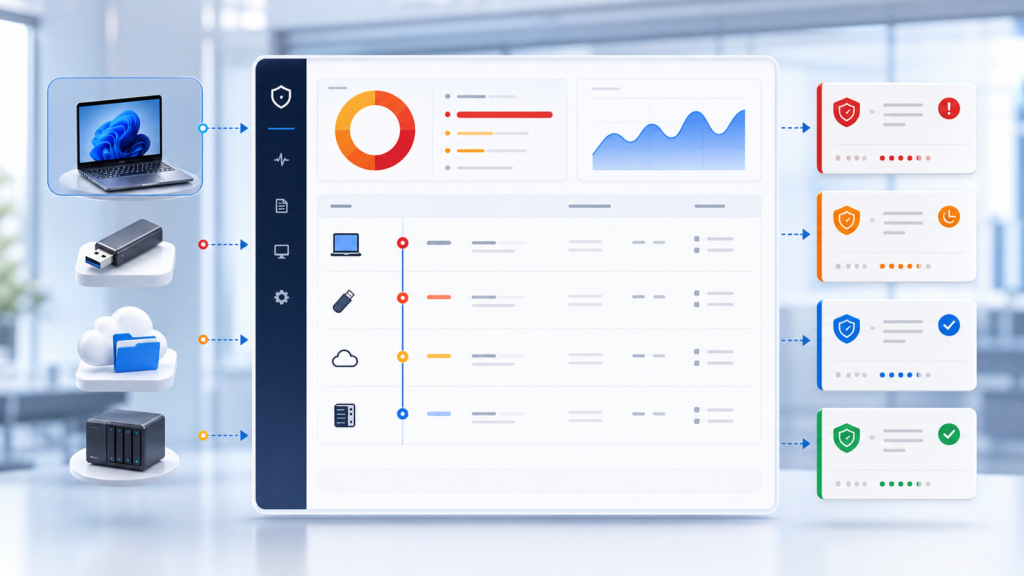
Confirm which endpoint, USB, sync-folder and network-share events matter.
Tune rules with real context
Measure false positives and document legitimate applications and workflows.
Create a review process
Define ownership, business validation, notes and incident closure criteria.
What the business prepares
A useful pilot requires both technical scope and people who understand the business context.
Technical scope
- Representative Windows endpoints.
- Approved folders and destinations to observe.
Data context
- Priority document types, naming patterns and risk scenarios.
- Retention and privacy requirements.
Operational owners
- IT or security reviewer.
- Business stakeholders who validate legitimate activity.
Pilot criteria
- Signals and evidence expected in incidents.
- Operationally manageable false-positive level.
Approved exceptions
- Backup, migration, sync or business applications.
- Special user and endpoint groups.
Decision framework
- Evidence required to expand, redesign, hold or stop.
Deliverables by pilot phase
Each phase produces evidence rather than a generic completion statement.
Phase
Deliverable
Status
Discovery
Scope, channel map, representative group and responsibility matrix.
Current
Baseline
Normal-activity observations, noise sources and initial exceptions.
Current
Rule tuning
Rule list, reviewed incidents, false positives and change history.
Current
Pilot review
Evidence summary, remaining risk and recommended next step.
Current
Commercial rollout
License, SLA and rollout terms require future commercial confirmation.
Pending
EVIDENCE-LED PILOT
A five-stage implementation approach
The pilot progresses from discovery to a documented decision rather than assuming that rollout is always the right outcome.
- Map data workflows, endpoints and objectives.
- Deploy the agent and validate secure connectivity.
- Collect a normal-activity baseline.
- Run rules, review incidents and tune exceptions.
- Summarize evidence and recommend the next stage.
How pilot success is assessed
01. Coverage
Does the incident include the endpoint, user, destination and scale needed for review?
02. Signal quality
Can rules distinguish risk from backup, sync and legitimate bulk work?
03. Operability
Can the team assign, review, document and close incidents consistently?
04. Readiness
Is there enough evidence to expand, redesign or pause?
DLP pilot implementation FAQs
How long does a DLP pilot take?
Duration depends on endpoint count, rules, data use cases and review speed. A schedule is confirmed after discovery, not invented in advance.
Must every endpoint be included?
No. A representative sample should cover relevant departments, device profiles and data workflows.
Does the pilot block employees?
The current product emphasizes audit, alerts and incident review. Endpoint block and quarantine are not completed capabilities.
Who should participate besides IT?
Business stakeholders should validate whether unusual activity is legitimate and help define exceptions.
Can rules change during the pilot?
Yes. Every change should be documented so the team can see which adjustment improved or degraded signal quality.
Is rollout mandatory after the pilot?
No. The evidence may support expansion, a redesigned scope, continued observation or stopping.
Related DLP pages
Start a DLP pilot with measurable evidence
Share your endpoint count, priority channels and data-risk objectives. IT Systems will propose a representative group, required inputs and evaluation criteria.