


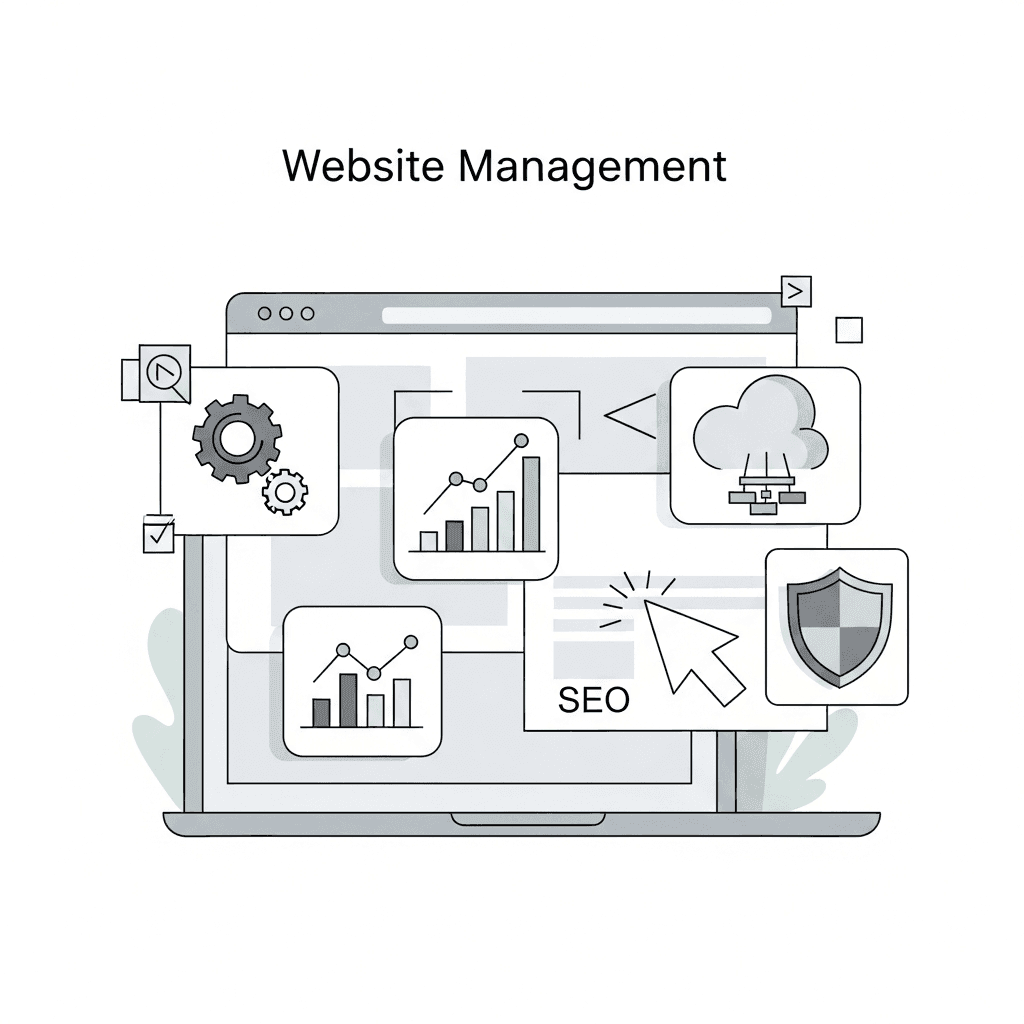
Website Management is the key factor determining the success of small and medium-sized enterprises (SMEs) in the digital era. Not just a marketing tool, a website is also the central IT infrastructure supporting all business operations, from customer outreach to online transaction processing. However, many SMEs are struggling to maintain a stable system, leading to downtime, data loss, and high security risks.
According to statistics, over 70% of Vietnamese SMEs use cheap hosting without clear SLAs, causing websites to frequently slow down and disrupt. This not only affects user experience but also reduces SEO rankings and loses valuable organic traffic. Professional website management services have emerged to comprehensively solve these issues, ensuring 99.9% uptime, optimal page load speed according to Core Web Vitals, and comprehensive security.
Effective website management requires systems thinking, combining robust cloud infrastructure, standardized SOP processes, and 24/7 monitoring. Businesses can flexibly scale resources according to business needs, tightly control TCO, and minimize IT risks. Especially for SMEs, the Hybrid model—self-managing content combined with outsourcing infrastructure—is becoming the most optimal trend.
In this article, we will deeply analyze common system risks, prevalent technical mistakes, and comprehensive transformation strategies. Through real case studies, you will see how a website can triple its traffic in just a few months after optimization. Finally, a decision framework helps SMEs choose the most suitable website management model for their budget and business goals.
To learn more about comprehensive solutions, explore professional website management services.
1. Website Management from IT Systems’ Perspective: Identifying System Risks for SMEs
A website is not merely a marketing tool; it is a critical infrastructure foundation for business operations. For small and medium-sized enterprises (SMEs), identifying and managing IT system risks is vital. This is evident in the daily challenges they face, from downtime risks to SLA violations causing direct revenue loss. These incidents can severely impact the company’s image and reputation in the market.
Data loss and security breaches remain major concerns when systems lack proper protection and are exploited due to inadequate professional security solutions. Additionally, relying on a single IT staff member for system management creates a potential single point of failure, leading to operational disruptions in emergencies.
Inability to control total cost of ownership (TCO) for website operations is another issue for many businesses. Cost instability can hinder investment capacity in infrastructure and IT services improvements, affecting overall development efficiency. To improve, businesses can refer to successful case studies in managing and optimizing IT systems through professional solutions.
2. Common Mistakes & Technical “Blind Spots” When SMEs Self-Manage Websites
Using only Shared/Cheap Hosting without SLA commitments on performance/Uptime: SMEs often rely solely on shared/cheap hosting packages, leading to no commitments on performance and uptime, significantly affecting website load speed and user experience. Investing in a reputable hosting service with clear SLAs will dramatically improve performance and reliability.
Lacking Comprehensive Backup & Restore Strategy: Many business owners confuse file copying with RTO/RPO recovery scenarios, putting data at high risk during incidents. Defining clear backup strategies not only protects data but also minimizes downtime.
Underestimating Technical Security Importance: Using free plugins for security management may not be robust enough against current cyber threats. Tools like WAF and Patch Management need to be implemented for better protection.
Lacking Monitoring & Logging Tools: Without prioritizing monitoring tool implementation, many technical issues go undetected in time, leading to reduced incident resolution efficiency. Integrating automated monitoring systems enhances proactive detection and handling capabilities.
Root Causes: A primary reason for ineffective website management is the internal IT team’s lack of web infrastructure expertise. Investing in specialized training or outsourcing to experts can help businesses overcome these challenges.
3. Operational Transformation Strategy: Implementing Website Management Solutions with Systems Thinking
In the operational transformation process, evaluating and optimizing website infrastructure is the core focus. Migrating from legacy systems to Cloud/VPS models ensures scalability and stable performance. Businesses can easily upgrade resources like RAM or GPU according to current business needs, while enjoying flexible costs through monthly payments or pay-per-use.
Building standardized operating procedures (SOPs) and establishing SLAs for both internal teams and external partners clearly define service and collaboration standards, enhancing reliability and efficiency. SOPs not only standardize processes but also serve as key tools to minimize errors in management and operations, thereby improving customer experience and productivity.
Setting up continuous monitoring systems with Monitoring and Logging tools to track and alert on key metrics like CPU, Memory, Bandwidth, and page load speed. This enables timely action before minor issues escalate into major incidents affecting user experience. This not only reduces downtime but also sustainably optimizes system efficiency.
Implementing enhanced security strategies like DDoS Mitigation and WAF is essential to protect infrastructure from external threats. Especially in the Marketing industry, security is a deciding factor in maintaining data integrity and customer trust. Ensuring automated Backup & Restore mechanisms and periodic RPO/RTO testing not only sustains efficient operations but also enhances recovery capabilities post-incident, ensuring business continuity.
4. Measuring Overall Effectiveness: From Traffic Growth to TCO Optimization and Downtime Reduction
Improving technical metrics like actual uptime ratio plays a crucial role in website management. Ensuring 99.9% SLA not only maintains stability but also builds customer trust. This criterion is particularly vital for SMEs, where every minute of downtime can cause significant revenue loss. Alongside, reducing mean time to recovery (MTTR) optimizes time and costs, ensuring quick issue resolution.
Page load speed, part of Core Web Vitals, attracts and retains customers faster. It not only enhances user experience but also improves conversion rates, becoming a key factor in website optimization.
From a business perspective, reducing Total Cost of Ownership (TCO) through infrastructure optimization is an effective strategy. Proper technology investment not only saves budget but also boosts productivity. Modern tech solutions optimize operational processes, positively impacting conversion rates.
Finally, analyzing comparisons of IT and Business Metrics before and after implementing website management solutions clearly demonstrates the effectiveness of partnering with a professional marketing agency. Performance evaluation at time intervals enables proactive management in strategy adjustments, sustaining and growing website traffic.
5. Case Study Analysis: From Slow Website to 3X Traffic Growth Thanks to System Optimization
In a specific scenario, a finance industry client faced a sluggish website severely impacting business operations and user experience. Before optimization, the management team conducted in-depth analysis of core technical issues like infrastructure, backup systems, and security. Challenges like downtime and data loss became top priorities for timely resolution.
To address this, the business migrated from shared hosting to a more robust cloud infrastructure. This process included setting up continuous monitoring systems and integrating advanced security protocols to protect customer data.
The results were a threefold traffic increase in just a few months. Additionally, technical metrics like service downtime significantly decreased, while total cost of ownership (TCO) was optimized, delivering sustainable economic benefits.
Reality shows, An Toàn Nam Việt – Website Optimization: From Slow to 180% Online Revenue Growth in Just 6 Months
6. Decision Framework for SMEs: Choosing the Optimal Website Management Model
Assessing needs is the crucial first step in selecting the optimal website management model for SMEs. Thorough analysis based on available budget, current system complexity, and SLA requirements helps businesses clearly define their needs. Businesses must consider if affordability aligns with website complexity and uptime/RTO standards.
When considering in-house operations, this solution suits businesses with simple requirements and limited budgets. It’s a good choice when strict SLA commitments aren’t needed, or when the business has basic IT-savvy staff for self-management. However, risks of lacking professionalism and quick incident handling can impact overall system performance.
For businesses with high security needs and requiring uptime guarantees (SLA 99.9%) with clear recovery times, full outsourcing (Managed Service) is worth considering. Managed Service Providers offer professional services, ensuring stable and enhanced security operations through continuous management and maintenance.
The Hybrid model is favored by many SMEs for its flexibility and cost-effectiveness, allowing self-management of content and marketing activities while outsourcing infrastructure and security to experts. This enables businesses to focus on core operations without technology risks, enhancing flexibility, control, and market competitiveness.
7. IT Systems – Comprehensive Operations Partner: SLA Commitments and Stable Security
Core Benefits of IT Systems Services: Businesses often face system disruption risks and security threats causing major revenue and reputation losses. IT Systems commits to 24/7 stable operations, minimizing unexpected incidents and optimizing performance beyond what a marketing agency can provide. The difference lies in deep expertise in technology infrastructure management, ensuring uninterrupted business operations.
Value Commitment Metrics: Aiming for the highest SLA, IT Systems focuses on optimizing total cost of ownership (TCO) for businesses. This commitment goes beyond maintaining good uptime to establishing sustainable IT systems with tightly controlled costs. This investment maximizes resources for SMEs while ensuring safety and flexibility.
Call to Action: SMEs should take advantage of the free website infrastructure assessment offered by IT Systems. This helps gain clear insight into system status, make smarter decisions with the in-depth Decision Framework, and drive growth without increasing management costs.
FAQ
When should a business ask IT Systems for support?
Ask for support when the issue affects users, business data, security, licensing compliance, service availability or daily operations. A short technical review often prevents repeated incidents and hidden costs.
Can IT Systems help review the current environment before proposing a solution?
Yes. IT Systems can review the current setup, identify risks, map the issue to the right service scope and recommend a practical next step for your business.
Does this topic connect to ongoing IT operations?
In most cases, yes. Problems around software, cloud, endpoint, network, backup or security should be connected to a broader IT operations plan instead of being handled as isolated incidents.
Need help applying this to your business?
IT Systems Vietnam can help assess the issue, recommend the right service path and support implementation for your team.


