


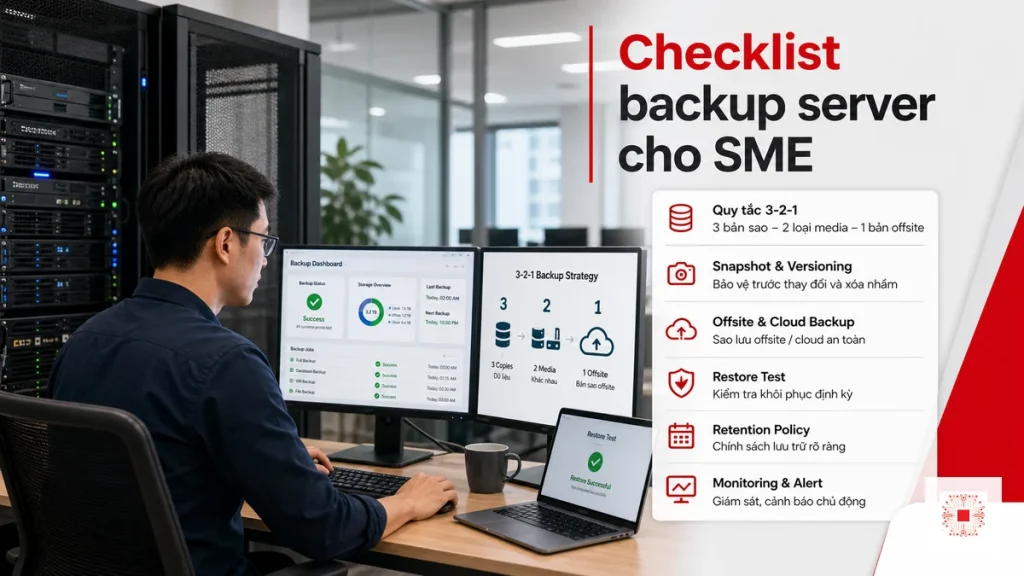
Server Backup Checklist for SMEs: How to Back Up So You Can Actually Restore is a practical guide for SMEs that need a reliable operating process, clear ownership and measurable verification criteria. It explains what to check, what can go wrong and how to decide the next step.
If you need implementation support, review business cloud solutions with IT Systems before starting.
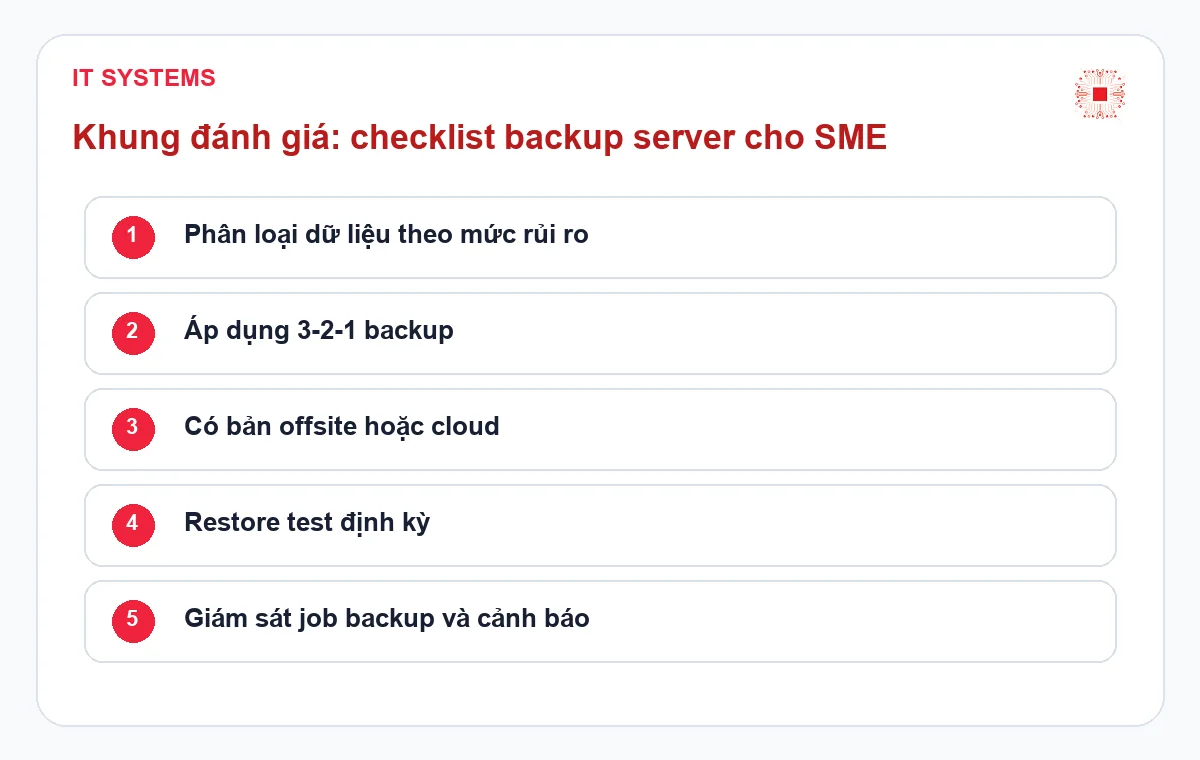
Why Server Backup Is More Than Having One Copy
Many SMEs believe that one backup folder on the same server or NAS is enough. In reality, backup only matters when the copy is separated from the main risk, retained long enough and tested through restore. If ransomware encrypts both the server and backup folder, the business is effectively unprotected. In a real implementation, this point should become an operational checklist with an owner, schedule and verification evidence. The business should identify which data affects revenue, which data creates compliance risk and which data only creates inconvenience if lost. That classification makes the backup plan measurable instead of relying on assumptions. A useful SME backup standard also separates backup success from restore readiness. Many companies receive a green backup notification but have never tested whether the files, databases and application settings can be restored within the promised recovery window. For that reason, the checklist should include sample restore tests, clear retention rules, offsite copies and documented recovery steps that another technician can follow when the usual administrator is unavailable.
In a real SME operation, this item should create evidence, not only a checklist tick. The owner should record check time, backup status, restore-test result, open risk and the next recommendation. If the business does not have that process, it should review cloud and backup support from IT Systems to define RPO, RTO and support scope.
How to Apply the 3-2-1 Rule
The 3-2-1 rule means at least three copies of data, on two different media types, with one copy offsite or in the cloud. A practical SME setup includes production data, a local backup for fast restore and a cloud/offsite backup for disaster recovery. In a real implementation, this point should become an operational checklist with an owner, schedule and verification evidence. The business should identify which data affects revenue, which data creates compliance risk and which data only creates inconvenience if lost. That classification makes the backup plan measurable instead of relying on assumptions. A useful SME backup standard also separates backup success from restore readiness. Many companies receive a green backup notification but have never tested whether the files, databases and application settings can be restored within the promised recovery window. For that reason, the checklist should include sample restore tests, clear retention rules, offsite copies and documented recovery steps that another technician can follow when the usual administrator is unavailable.
In a real SME operation, this item should create evidence, not only a checklist tick. The owner should record check time, backup status, restore-test result, open risk and the next recommendation. If the business does not have that process, it should review cloud and backup support from IT Systems to define RPO, RTO and support scope.
Which Data Should Be Prioritized
Not all data needs the same backup schedule. Accounting databases, contracts, customer data and system configuration should be prioritized over temporary files. Classification helps control storage cost while protecting business-critical data. In a real implementation, this point should become an operational checklist with an owner, schedule and verification evidence. The business should identify which data affects revenue, which data creates compliance risk and which data only creates inconvenience if lost. That classification makes the backup plan measurable instead of relying on assumptions. A useful SME backup standard also separates backup success from restore readiness. Many companies receive a green backup notification but have never tested whether the files, databases and application settings can be restored within the promised recovery window. For that reason, the checklist should include sample restore tests, clear retention rules, offsite copies and documented recovery steps that another technician can follow when the usual administrator is unavailable.
In a real SME operation, this item should create evidence, not only a checklist tick. The owner should record check time, backup status, restore-test result, open risk and the next recommendation. If the business does not have that process, it should review cloud and backup support from IT Systems to define RPO, RTO and support scope.
Backup Frequency and Retention
Backup frequency depends on how fast data changes. Sales and accounting data may need daily or multiple daily backups, while archive files can use a slower schedule. Retention must be long enough to recover from delayed ransomware discovery. In a real implementation, this point should become an operational checklist with an owner, schedule and verification evidence. The business should identify which data affects revenue, which data creates compliance risk and which data only creates inconvenience if lost. That classification makes the backup plan measurable instead of relying on assumptions. A useful SME backup standard also separates backup success from restore readiness. Many companies receive a green backup notification but have never tested whether the files, databases and application settings can be restored within the promised recovery window. For that reason, the checklist should include sample restore tests, clear retention rules, offsite copies and documented recovery steps that another technician can follow when the usual administrator is unavailable.
| Area | What to Check | Verification |
|---|---|---|
| Risk | Data, downtime, security and cost | Clear mitigation exists |
| Operations | Owner, schedule and alerts | Checklist and report exist |
| Handover | Accounts, documents and test results | No personal dependency |
In a real SME operation, this item should create evidence, not only a checklist tick. The owner should record check time, backup status, restore-test result, open risk and the next recommendation. If the business does not have that process, it should review cloud and backup support from IT Systems to define RPO, RTO and support scope.
Restore Test Is Mandatory
A backup plan that has never been restored is only an assumption. Restore tests should include a single file, a database and a full service recovery. The result should document restore time, data completeness and issues found. In a real implementation, this point should become an operational checklist with an owner, schedule and verification evidence. The business should identify which data affects revenue, which data creates compliance risk and which data only creates inconvenience if lost. That classification makes the backup plan measurable instead of relying on assumptions. A useful SME backup standard also separates backup success from restore readiness. Many companies receive a green backup notification but have never tested whether the files, databases and application settings can be restored within the promised recovery window. For that reason, the checklist should include sample restore tests, clear retention rules, offsite copies and documented recovery steps that another technician can follow when the usual administrator is unavailable.
In a real SME operation, this item should create evidence, not only a checklist tick. The owner should record check time, backup status, restore-test result, open risk and the next recommendation. If the business does not have that process, it should review cloud and backup support from IT Systems to define RPO, RTO and support scope.
Monitoring and Alerting
Silent backup failure is common. The business needs alerts for failed jobs, full storage, old restore points and repository access problems. Monthly reports should show successful jobs and the latest restore test. In a real implementation, this point should become an operational checklist with an owner, schedule and verification evidence. The business should identify which data affects revenue, which data creates compliance risk and which data only creates inconvenience if lost. That classification makes the backup plan measurable instead of relying on assumptions. A useful SME backup standard also separates backup success from restore readiness. Many companies receive a green backup notification but have never tested whether the files, databases and application settings can be restored within the promised recovery window. For that reason, the checklist should include sample restore tests, clear retention rules, offsite copies and documented recovery steps that another technician can follow when the usual administrator is unavailable.
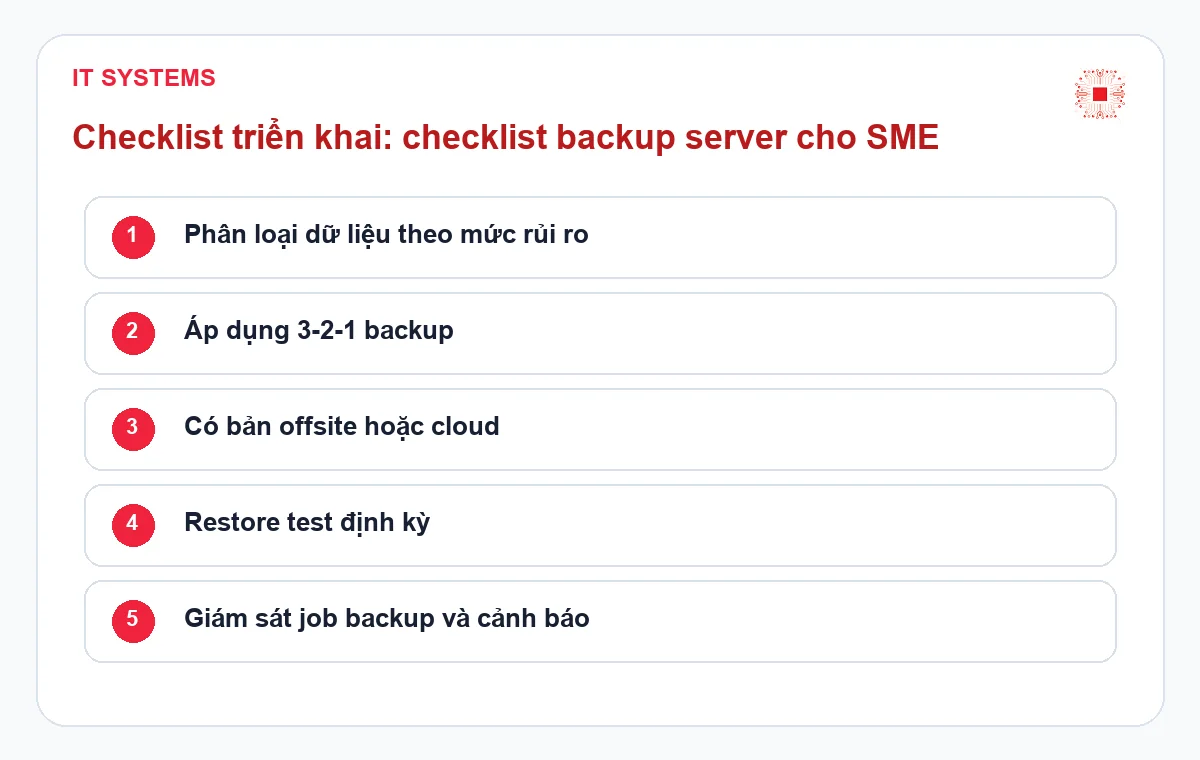
In a real SME operation, this item should create evidence, not only a checklist tick. The owner should record check time, backup status, restore-test result, open risk and the next recommendation. If the business does not have that process, it should review cloud and backup support from IT Systems to define RPO, RTO and support scope.
When Cloud Backup Makes Sense
Cloud backup is useful when the company needs an offsite copy, scalable storage and protection from office-level incidents. It still requires encryption, MFA, permissions and cost control. In a real implementation, this point should become an operational checklist with an owner, schedule and verification evidence. The business should identify which data affects revenue, which data creates compliance risk and which data only creates inconvenience if lost. That classification makes the backup plan measurable instead of relying on assumptions. A useful SME backup standard also separates backup success from restore readiness. Many companies receive a green backup notification but have never tested whether the files, databases and application settings can be restored within the promised recovery window. For that reason, the checklist should include sample restore tests, clear retention rules, offsite copies and documented recovery steps that another technician can follow when the usual administrator is unavailable.
In a real SME operation, this item should create evidence, not only a checklist tick. The owner should record check time, backup status, restore-test result, open risk and the next recommendation. If the business does not have that process, it should review cloud and backup support from IT Systems to define RPO, RTO and support scope.
Need a safer server backup plan?
IT Systems can audit your server, design a 3-2-1 backup plan, configure cloud/offsite backup, test restore and hand over an operating checklist. In a real implementation, this point should become an operational checklist with an owner, schedule and verification evidence. The business should identify which data affects revenue, which data creates compliance risk and which data only creates inconvenience if lost. That classification makes the backup plan measurable instead of relying on assumptions. A useful SME backup standard also separates backup success from restore readiness. Many companies receive a green backup notification but have never tested whether the files, databases and application settings can be restored within the promised recovery window. For that reason, the checklist should include sample restore tests, clear retention rules, offsite copies and documented recovery steps that another technician can follow when the usual administrator is unavailable.
In a real SME operation, this item should create evidence, not only a checklist tick. The owner should record check time, backup status, restore-test result, open risk and the next recommendation. If the business does not have that process, it should review cloud and backup support from IT Systems to define RPO, RTO and support scope.
Recommended Next Step
Start with a short audit, identify the highest-risk area, implement a limited scope and measure the result before expanding. IT Systems can support consulting, implementation and handover through business cloud solutions. In a real implementation, this point should become an operational checklist with an owner, schedule and verification evidence. The business should identify which data affects revenue, which data creates compliance risk and which data only creates inconvenience if lost. That classification makes the backup plan measurable instead of relying on assumptions. A useful SME backup standard also separates backup success from restore readiness. Many companies receive a green backup notification but have never tested whether the files, databases and application settings can be restored within the promised recovery window. For that reason, the checklist should include sample restore tests, clear retention rules, offsite copies and documented recovery steps that another technician can follow when the usual administrator is unavailable.
In a real SME operation, this item should create evidence, not only a checklist tick. The owner should record check time, backup status, restore-test result, open risk and the next recommendation. If the business does not have that process, it should review cloud and backup support from IT Systems to define RPO, RTO and support scope.
Decision Priority Table
The table below helps the business choose a practical service level instead of deciding only by the lowest price.
| Criteria | Basic Level | Operations Level | Advanced Level |
|---|---|---|---|
| Business impact | Low, few users | Affects core teams | Affects revenue or data |
| SLA | Office-hour support | Incident priority and faster response | Defined SLA with escalation |
| Evidence | Simple checklist | Monthly report | Logs, tests, handover and improvement plan |
The key is to decide which risks must be fixed now, which risks should be monitored monthly and which risks deserve a separate improvement plan. Management should also assign an owner for each risk so the checklist becomes part of operations, not a one-time document.
Implementation Governance and Monthly Reporting Framework
To avoid treating the topic as a one-time consultation, the business should turn recommendations into a monthly control framework. The framework should include an owner, open risks, review dates, implementation evidence, status and next actions. For SMEs, this helps management understand whether the system is truly stable or merely has not produced visible incidents yet.
When IT Systems supports the work, the deliverable should be reusable: current-state checklist, service scope, priority items, implementation conditions, required accounts and permissions, acceptance criteria and reporting schedule. This reduces dependence on a single technical person and helps sales, marketing, accounting and operations understand their role in keeping the system reliable.
| Control Item | Purpose | Evidence |
|---|---|---|
| Open risks | Know what is not resolved yet | Monthly priority list |
| Owner | Avoid unclear responsibility | Named person or team |
| Acceptance | Confirm the change works | Screenshot, log, test or report |
This section also gives the business a practical way to compare providers. A lower price may be acceptable for a low-risk setup, but if the provider cannot show evidence, ownership and reporting, management will have difficulty knowing whether the service is actually reducing risk.
What Management Should Review Before Approval
Before approving the service scope, management should review three practical questions. First, what business process will be affected if the system fails? Second, who inside the company owns approval, communication and acceptance testing? Third, what evidence will be reviewed monthly to confirm that the service is working as expected? These questions make the decision concrete and prevent technical work from becoming disconnected from business operations.
The review should also separate urgent risk reduction from future optimization. Some items, such as broken authentication, missing backup, failed forms or unclear admin access, may need immediate action. Other items, such as performance tuning, reporting improvement or workflow automation, can be scheduled after the baseline is stable. This phased approach keeps the project realistic for SME budgets while still moving the system toward a more professional operating model.
Need IT Systems to Review This Before Implementation?
IT Systems can review the current setup, risks, data, accounts, backup, DNS, licensing, SLA and handover plan before implementation. The business receives a priority list, recommended scope and a practical service package direction.
This is useful when the system affects email, websites, data or multiple business teams. The review should produce a practical next-action list, including what must be fixed immediately, what should be monitored monthly and what can be planned as a later improvement. The final deliverable should be simple enough for management to approve and detailed enough for technical staff to execute without guessing.


