


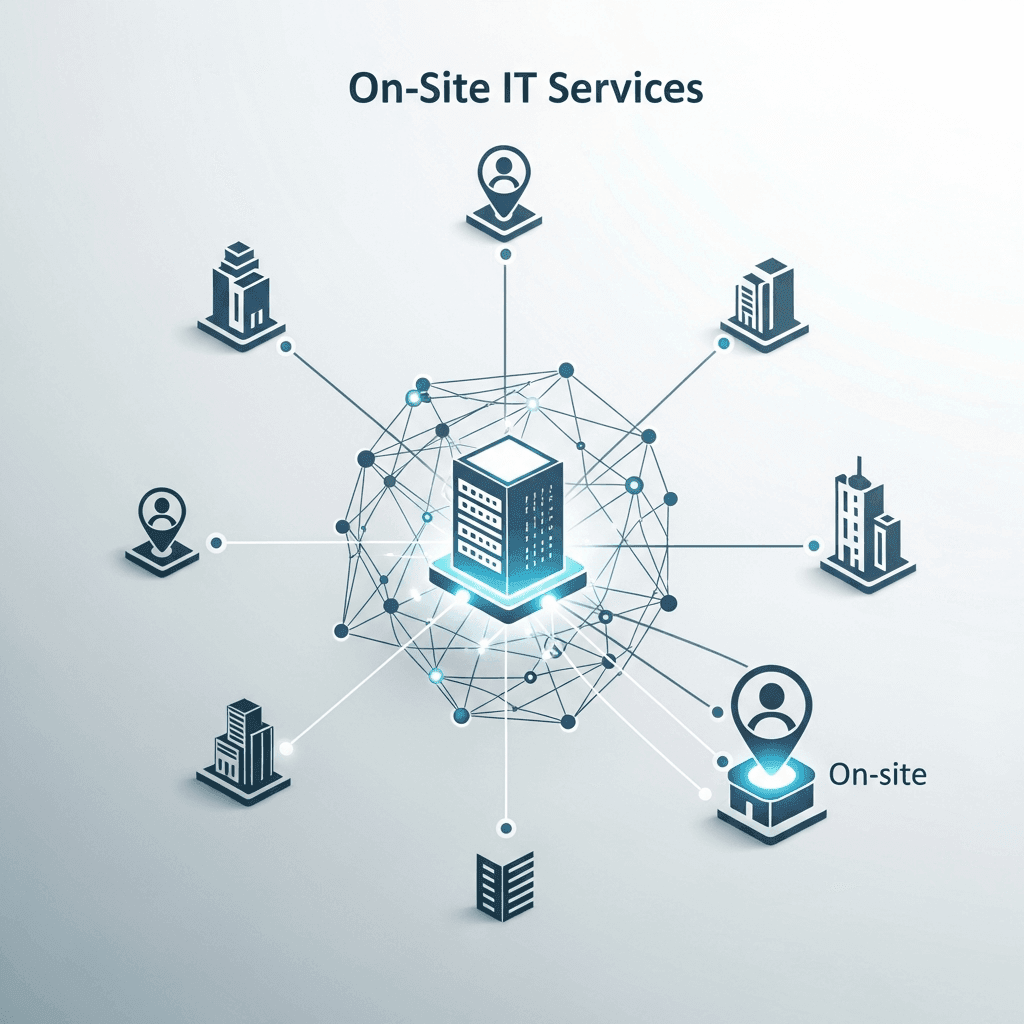
Onsite IT service is becoming a top choice for small and medium-sized enterprises (SMEs) in Vietnam, offering specialized technical support right at the workplace. In the context of strong digital technology development, maintaining a stable IT system is a decisive factor in the success of any organization. This service not only helps resolve incidents quickly but also optimizes infrastructure, minimizes downtime, and enhances labor productivity.
In particular, with the hire onsite IT model, businesses can access a team of experts without a large investment in permanent staff. Instead of hiring full-time employees at a high cost, companies only pay based on actual needs, flexibly adjusting to their business scale. This is especially suitable for startups or medium-sized businesses where budgets are limited but IT support requirements are high. Moreover, onsite technicians can directly handle complex hardware issues such as server failures, internal network disruptions, or new equipment installations, ensuring business operations are not interrupted.
Compared to traditional solutions, onsite IT stands out due to its high level of interaction. An IT staff member present on-site allows for direct communication, accurate diagnosis, and immediate solution implementation. This minimizes misunderstandings common in remote support. According to industry reports, businesses using onsite IT services reduce incident resolution time by up to 40% compared to self-management. Additionally, the service also includes periodic maintenance, software updates, and internal training, helping to keep the system in an optimal state.
In the era of hybrid work, combining onsite IT service with remote support creates a comprehensive IT ecosystem. Businesses can leverage onsite support for urgent issues and remote support for daily maintenance. To explore further, you can refer to the professional IT support service from IT Systems. With experience serving hundreds of customers, we are committed to providing customized solutions, helping businesses focus on their core business without worrying about technology.
Finally, choosing a reputable provider is key. Evaluate based on response time, transparent costs, and SLA commitments. Onsite IT service is not just technical support but also a strategic partner driving sustainable growth.
1. Introduction to Onsite IT Service and Remote Support
Onsite IT service is typically deployed at the business’s own location to provide fast and specific technical support. Its role is to ensure the information technology infrastructure always operates effectively while quickly resolving any emerging issues, thereby optimizing the entire organization’s work performance. For small businesses, using onsite IT service helps significantly reduce system downtime and optimize the cost of hiring permanent IT staff.
Remote IT support, on the other hand, offers flexibility and convenience, allowing technicians to resolve technology issues over the Internet without needing to be physically present at the company. This is particularly useful for businesses with multiple branches or remote employees. Remote support not only minimizes travel costs but also provides flexibility in working hours and access to a broader IT workforce without geographical limitations.
For small businesses, combining these two models can bring optimal benefits. Onsite IT service ensures that physical issues and those requiring immediate presence are handled quickly, while remote support helps optimize costs and resources, especially when issues do not require a physical presence. Both play an essential role in ensuring the continuity and stability of business operations.
An overview of the differences between these two models primarily lies in the deployment method and the main application targets. Onsite IT requires a physical presence, suitable for issues that need to be resolved immediately on-site, while remote support can be performed flexibly, saving costs and time.
| IT Onsite | Remote Support | |
|---|---|---|
| Deployment | Directly at the business premises | Via the Internet |
| Cost | Higher due to travel requirements | Lower as travel costs are eliminated |
| Resolution Speed | Fast for physical issues | Fast for software issues |
2. Key Criteria for Comparing IT Support Models
Cost and Budget-Effectiveness: For small and medium-sized businesses, IT Systems’ IT Helpdesk and IT Support services are an ideal solution to optimize personnel costs. By providing a professional IT team for the cost of just one employee, businesses can reduce their cost burden while maintaining high operational performance. This is particularly important when businesses need to save costs without compromising service quality.
Response Time and Processing Speed: With the importance of quickly resolving IT incidents, our IT Helpdesk and IT Support services ensure that issues are resolved promptly, helping businesses restore operations quickly. This not only enhances efficiency but also minimizes downtime, which is crucial for businesses with both simple and complex systems.
Scope and Complexity of Incidents: Both services are capable of handling a range of IT issues, from simple to complex. IT Systems’ solutions are suitable for all needs and technical levels, from strategic consulting to system administration implementation and technical support.
Security and Data Safety Level: Security is a key element in IT Systems’ services. Designed to ensure the safety of data and network systems, our services provide comprehensive security solutions, helping businesses operate with peace of mind, free from concerns about information loss risks.
Proactive Maintenance and Prevention Capability: IT Systems offers proactive maintenance services to detect system errors early, helping to prevent incidents before they cause major disruptions. This enhances system stability and increases reliability for daily business operations.
Requirement for Physical and Direct Intervention: IT Systems’ services minimize the need for physical intervention thanks to an effective remote management system. This not only saves time but also allows for quick and efficient access to solutions on a global scale.
| Criteria | IT Helpdesk Service | IT Support Service |
|---|---|---|
| Cost | Saves personnel costs | Comprehensive maintenance solution |
| Response time | Fast, timely | Timely incident handling |
| Security | Ensures security and safety | Enhances data security |
3. In-depth Analysis of Onsite IT Service
Advantages and Direct Benefits: Onsite IT Service offers flexibility and cost optimization, especially when hiring a dedicated team. This helps businesses save on their budget compared to recruiting permanent staff. In particular, the ability to quickly handle technical issues ensures the IT system operates smoothly, minimizing downtime.
Disadvantages and Existing Limitations: Despite its many benefits, Onsite IT Service also has some limitations, such as dependency on the provider’s response time and costs that can increase if service is required outside of business hours or on an urgent basis.
Most Suitable Use Cases: This service is suitable for small and medium-sized businesses in IT, finance, marketing, and many other fields that require a continuous and robust IT system. Businesses that do not specialize in IT can also benefit from this service to avoid work interruptions.
Hardware Troubleshooting Capability: With a team of professional technicians, Onsite IT Service provides quick solutions for on-site hardware incidents, helping businesses maintain operations without long waits.
Interaction and Personal Communication Factor: One of the major advantages of Onsite IT Service is the ability for direct communication and on-the-spot problem-solving. This helps minimize errors that can occur when communicating information over the phone or via email.
Cost and Service Pricing Models: Pricing models are often flexible, available as monthly service packages or on a per-use basis. This allows businesses to adjust their budgets and pay only for the services they truly need.
Impact on Internal Work Performance: Support from Onsite IT Service helps businesses maintain and improve work performance, as all incidents are resolved promptly, preventing disruptions to daily activities.
4. Comprehensive Evaluation of the Remote IT Support Model
Advantages of the Remote Support Model: Remote IT support offers many outstanding benefits, such as saving on personnel costs, as a business can hire a professional team for a fee equivalent to just one employee. Furthermore, these solutions are flexible and tailored to the specific needs of each company, ensuring stable work performance and minimizing downtime. This helps businesses optimize their IT systems without a large investment in internal staff.
Disadvantages and Inherent Limitations: However, the remote support model is not without its drawbacks. One significant limitation is the limited ability to handle hardware incidents. When a serious issue occurs, the lack of a physical presence can disrupt business operations. Moreover, data security must be carefully considered, as remote work can pose a risk of information leakage.
Effectiveness Comparison with On-site Support: Compared to on-site support, remote support is often faster and more flexible for software and system issues. However, when dealing with hardware problems, the presence of an on-site technician still holds a significant advantage, allowing for quicker and more thorough resolution. This is particularly important for businesses that require high operational stability.
Factors to Consider When Choosing: When deciding between remote or on-site IT support models, businesses need to consider many factors such as flexibility, cost, and specific system requirements. Furthermore, assessing the current state and future scalability is also crucial to ensure the chosen model can meet long-term growth needs.
Hardware Troubleshooting Capability: In the case of a hardware incident, the remote support model can be limited due to the inability to intervene directly. Therefore, businesses need to prepare specific contingency plans or combine remote and on-site services to ensure all incidents are handled promptly and effectively.
5. Overview Comparison: Onsite IT Service and Remote Support
As businesses increasingly focus on optimizing costs and investment efficiency, comparing onsite IT service and remote support becomes a critical factor. In terms of cost, onsite IT service can create a fixed expense when a business needs an IT employee present on-site to manage and handle incidents. Conversely, remote support is often more flexible financially, allowing businesses to pay only for the services they actually need while leveraging a professional IT team from various resources.
Response and issue resolution time is one of the disadvantages of onsite IT when compared to remote support, as a remote team can quickly access issues via online tools without needing to travel to the location. This is especially useful for small businesses with limited staff and facilities.
Another advantage of remote support is its broader scope of issue resolution, from handling software problems to assisting with remote hardware upgrades. Meanwhile, onsite IT may be superior in handling complex hardware incidents that require physical inspection.
For small and medium-sized businesses not in the IT industry, training support and security requirements can be arranged flexibly through online courses and remote compliance checks. This is a convenient solution that helps businesses avoid work interruptions while still ensuring security effectiveness. In necessary situations, hiring an onsite IT service can be the choice when a business needs to deploy a new network infrastructure or encounters a serious hardware failure.
7. Contact Us Now for the Most Suitable IT Support Solution
Customized Solution Consulting: We offer flexible IT solution consulting services tailored to each business. Optimizing your information technology infrastructure not only helps reduce costs but also enhances work efficiency.
Free IT Needs Assessment: Meet your business needs comprehensively with a free IT needs assessment. This helps detect potential issues early and proposes suitable improvement solutions, supporting your business in achieving sustainable benefits.
Information and Contact Form: To speak directly with our team of experts, fill out the contact form, and our team will quickly respond to your needs. This process ensures all requests are handled promptly and efficiently.
Professional Service Commitment: Committed to maintaining the highest quality of service, our IT team will always be ready to support you at every step of system implementation and operation, a commitment now recognized by reputable organizations.
Receive a Detailed Quote: After consulting and assessing your needs, you will receive a detailed quote from us. This method ensures you have a clear understanding of the costs and value provided before deciding to invest in an IT solution, thereby enhancing your business’s efficiency and competitiveness.
FAQ
When should a business ask IT Systems for support?
Ask for support when the issue affects users, business data, security, licensing compliance, service availability or daily operations. A short technical review often prevents repeated incidents and hidden costs.
Can IT Systems help review the current environment before proposing a solution?
Yes. IT Systems can review the current setup, identify risks, map the issue to the right service scope and recommend a practical next step for your business.
Does this topic connect to ongoing IT operations?
In most cases, yes. Problems around software, cloud, endpoint, network, backup or security should be connected to a broader IT operations plan instead of being handled as isolated incidents.
Need help applying this to your business?
IT Systems Vietnam can help assess the issue, recommend the right service path and support implementation for your team.


